
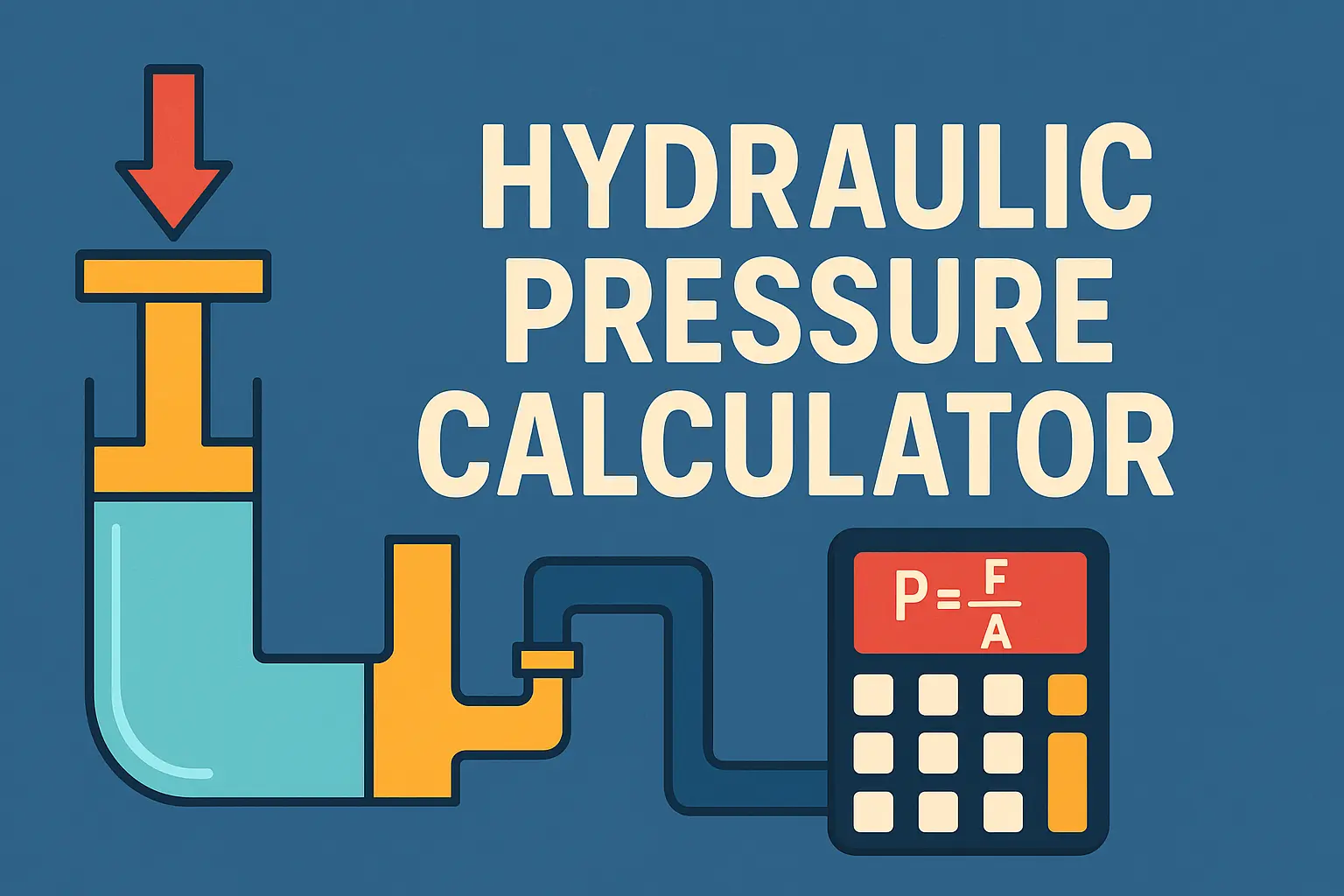
Hydraulic Pressure Calculator
Calculate pressure, force, and analyze fluid mechanics in hydraulic systems and submerged structures
P = ρ × g × h | Pressure increases with depth
📚 Understanding Hydraulic Pressure
Hydraulic pressure is the force per unit area exerted by a confined fluid. It's fundamental to countless engineering applications—from water dams and irrigation systems to hydraulic machinery, aircraft control systems, and submarine design. Understanding hydraulic pressure requires grasping how fluids behave when confined and how pressure varies with depth and fluid properties.
What is Hydraulic Pressure?
Pressure is defined as force divided by area: P = F/A. It has units of Pascals (Pa) or other pressure units. In fluids at rest (hydrostatic pressure), pressure is caused by the weight of fluid above acting on lower layers. The key insight: pressure in a static fluid increases linearly with depth according to: P = ρ × g × h, where ρ is fluid density, g is gravitational acceleration, and h is depth.
Gauge Pressure vs. Absolute Pressure
Absolute Pressure is the total pressure including atmospheric pressure: P_abs = ρ × g × h + P_atm (typically 101,325 Pa at sea level). Gauge Pressure is the excess above atmospheric: P_gauge = P_abs - P_atm = ρ × g × h. Most pressure gauges measure gauge pressure—the reading shows zero when exposed to atmosphere, even though absolute pressure exists. For engineering calculations, you must distinguish which type applies.
Pascal's Principle: The Foundation of Hydraulic Systems
Pascal's Principle states that pressure applied to a confined fluid is transmitted undiminished in all directions and throughout the fluid. This simple law explains why hydraulic systems are so powerful. In a hydraulic press with two pistons of different sizes: a small force on the small piston (area A₁) creates pressure P = F₁/A₁. This pressure acts on the large piston (area A₂), producing force F₂ = P × A₂ = F₁ × (A₂/A₁). Small pistons can lift enormous loads! This is how car jacks, heavy equipment, and aircraft control systems work.
How Fluid Density Affects Pressure
Pressure is directly proportional to fluid density: P = ρ × g × h. Denser fluids exert more pressure at the same depth. Water (ρ = 1000 kg/m³) is the reference standard. Mercury is much denser (ρ = 13,600 kg/m³)—that's why mercury barometers can measure atmospheric pressure with a column only 760 mm tall, whereas water barometers would be 10.3 meters tall! Oil is lighter than water (ρ = 800-900 kg/m³), so the same depth produces less pressure than in water.
Hydrostatic Force on Submerged Surfaces
When pressure acts on a surface, it creates force: F = P × A. For horizontal surfaces at constant depth h: F = ρ × g × h × A (pressure is uniform). For vertical surfaces, pressure varies with depth, so you must integrate. The resultant force acts at the centroid of pressure (below the geometric centroid). This is critical in dam design, where engineers calculate forces to ensure structural strength.
Buoyancy and Archimedes' Principle
Buoyant force arises from pressure differences: pressure is higher at the bottom of an object than at the top. The net upward force equals the weight of displaced fluid: F_b = ρ_fluid × g × V_displaced. This is Archimedes' Principle. Objects float when buoyant force equals weight. Understanding buoyancy is essential for ship design, submarine ballast calculations, and predicting whether objects will sink or float in various liquids.
Real-World Applications of Hydraulic Pressure
| Application | Key Pressure Concept | Why It Matters |
|---|---|---|
| Water Supply Systems | Pressure increases with elevation difference (P = ρgh) | Water flows from high to low pressure; pressure regulates flow rate |
| Dam Design | Hydrostatic force on vertical surface increases with depth | Force concentrates at depth; requires reinforced base |
| Hydraulic Jacks | Pascal's Principle (small force × area ratio = large force) | Small human effort lifts vehicles; enables machinery |
| Aircraft Brakes | Pascal's Principle transmits pilot's foot pressure to wheel brakes | Reliable, fail-safe braking; redundant systems critical |
| Submarine Design | Pressure increases ~100 kPa per 10 meters depth | Hull must withstand enormous crushing forces; limits operating depth |
| Oil Drilling | Pressure must be controlled to prevent blowouts | Drilling fluid density and circulation pressure critical |
Pressure Units and Conversions
Different fields use different pressure units. Pascal (Pa) is the SI standard. Bar equals 100,000 Pa and is common in engineering. Atmosphere (atm) is 101,325 Pa. PSI (pounds per square inch) is used in English-speaking countries. kPa (kilopascals) are convenient for most engineering. Understanding conversions is essential for international work and reading historical documents.
Why Engineers Need Hydraulic Pressure Calculations
Accurate pressure calculations are essential for: (1) sizing pumps and compressors for hydraulic systems, (2) ensuring structural components can withstand design pressures, (3) predicting flow behavior in pipes and channels, (4) calculating forces on gates, valves, and dams, (5) analyzing stability of submerged structures, (6) designing safety relief valves, (7) optimizing system efficiency and cost.
❓ Frequently Asked Questions
Hydraulic pressure is force per unit area: P = F/A (measured in Pascals). In a static fluid (at rest), pressure at a given depth equals: P = ρ × g × h, where ρ = fluid density (kg/m³), g = gravitational acceleration (9.81 m/s²), and h = depth below surface (meters). This formula shows pressure increases linearly with depth and fluid density. For example, at 10 meters depth in water: P = 1000 × 9.81 × 10 = 98,100 Pa ≈ 98 kPa of gauge pressure (or ~199 kPa absolute pressure including atmospheric pressure).
Absolute Pressure is the total pressure including atmospheric pressure: P_abs = ρ × g × h + P_atm. At sea level, P_atm = 101,325 Pa. Gauge Pressure is pressure above atmospheric: P_gauge = P_abs - P_atm = ρ × g × h. Most pressure gauges read zero when exposed to the atmosphere—they're measuring gauge pressure, not absolute. In engineering, you must specify which type you're using. For water at 10 meters: gauge pressure ≈ 98 kPa, but absolute pressure ≈ 199 kPa. Always clarify which type applies in your application.
Pascal's Principle states that pressure applied to a confined fluid is transmitted undiminished in all directions and throughout the fluid. This principle explains hydraulic power multiplication. In a hydraulic press, a small force F₁ on a small piston (area A₁) creates pressure P = F₁/A₁. This pressure acts everywhere in the confined fluid, including on a larger piston (area A₂), producing output force F₂ = P × A₂ = F₁ × (A₂/A₁). Example: if A₂ = 100 × A₁, then a 100 N input force produces 10,000 N output force! This principle enables car jacks, hydraulic excavators, aircraft control systems, and countless industrial machines. Without Pascal's Principle, hydraulic systems would be impractical.
Pressure is directly proportional to fluid density: P = ρ × g × h. Doubling the density doubles the pressure at the same depth. Water (ρ = 1000 kg/m³) is the standard reference. Mercury is 13.6 times denser (ρ = 13,600 kg/m³), so at the same depth, mercury exerts 13.6 times more pressure. That's why mercury barometers use a 760 mm column while water barometers need 10.3 meters! Oil is lighter than water (ρ = 800-900 kg/m³), producing less pressure at the same depth. Engineers select fluids based on required pressure, temperature range, lubricity, and cost.
Hydrostatic force is the total force exerted by pressure on a submerged surface. For a horizontal surface at constant depth: F = P × A = ρ × g × h × A. For vertical surfaces, pressure varies with depth, so the force equation is: F = ρ × g × h_c × A, where h_c is the depth to the centroid (center of area). The resultant force acts at the center of pressure, which is always below the centroid. This force is critical in dam design: a 20-meter tall dam experiences enormous force, increasing with depth—that's why dams are thick at the bottom. Engineers must calculate these forces to ensure structural safety.
Buoyant force arises directly from pressure differences in fluids. Pressure is higher at greater depth, so the bottom of a submerged object experiences more pressure (and upward force) than the top. The net result is an upward buoyant force: F_b = ρ × g × V, where V is the volume of displaced fluid. This is Archimedes' Principle. Objects float when buoyant force equals weight. Ships float because water displaced weighs more than the ship. Submarines adjust buoyancy by filling or emptying ballast tanks, changing their weight and buoyant force. Understanding this pressure-buoyancy relationship is essential for ship design, submarine operation, and predicting whether objects sink or float.
Hydraulic pressure calculations apply in: (1) Water Systems—designing pipes and pumps for pressure, (2) Dams and Locks—calculating structural forces, (3) Hydraulic Machinery—sizing pumps and cylinders using Pascal's Principle, (4) Submarines and Underwater Structures—ensuring hulls withstand pressure (increases ~100 kPa per 10 meters), (5) Irrigation Systems—designing gravity-fed distribution, (6) Oil Drilling—managing drilling fluid pressure to prevent blowouts, (7) Aircraft Systems—hydraulic control and braking, (8) Medical Devices—pneumatic and hydraulic actuators. Accurate calculations ensure safety, efficiency, and longevity of these systems.
SI Unit: Pascal (Pa) is the standard. 1 Pa = 1 N/m². Common Conversions: 1 bar = 100,000 Pa; 1 atm = 101,325 Pa; 1 PSI = 6,894.76 Pa; 1 kPa = 1,000 Pa. For practical engineering: kPa (kilopascals) are convenient (1 atm ≈ 101 kPa). Bar is widely used in Europe (1 bar ≈ 1 atm). PSI is standard in USA and UK (1 atm ≈ 14.7 PSI). When reading historical documents or international specifications, always verify which unit is being used. Using wrong units in calculations can cause massive errors!