Working with Vectors: Complete Guide, Formulas, Diagrams, and Practice Tool
Vectors describe quantities with both size and direction. They are used in coordinate geometry, transformations, mechanics, navigation, computer graphics, physics, engineering, economics, data science, and advanced mathematics. This page explains vectors from the ground up, with clear formulas, visual diagrams, worked examples, IB Mathematics assessment guidance, scoring notes, and an interactive vector tool for addition, subtraction, magnitude, dot product, angle, projection, cross product, line equations, and area problems.
Vector Tool Vector Basics Formula Bank Dot Product Cross Product Vector Lines IB Course Guide Practice FAQ
What this page helps you do
By the end of this guide, you should be able to represent vectors in component form, find magnitude, add and subtract vectors, multiply by scalars, calculate dot products, find angles, form unit vectors, use projections, understand vector equations of lines, and apply vector methods to geometry questions.
Why vectors matter
Vectors turn geometry into algebra. Instead of relying only on diagrams, you can use coordinates and formulas to prove direction, distance, angle, parallelism, perpendicularity, intersection, and area. This is why vectors are powerful in both exam mathematics and real-world modelling.
Exam focus
In IB Mathematics, vectors sit inside geometry and trigonometry. A strong answer usually combines accurate notation, correct formulas, clear reasoning, and a final interpretation. For IB-style work, students should also know when technology is allowed and when exact algebraic work is expected.
Interactive Vector Practice Tool
Enter two vectors \( \vec a \) and \( \vec b \), choose an operation, and the tool will show the result with formulas and steps. The SVG diagram uses the \(x\)- and \(y\)-components, so it gives a quick 2D visual even when you enter 3D vectors.
Vector inputs
2D vector diagram
The diagram plots \( \vec a \), \( \vec b \), and \( \vec a+\vec b \) using the first two components. It is meant for visual understanding, not for replacing algebraic working.
What Is a Vector?
A vector is a mathematical object with magnitude and direction. Magnitude means size or length. Direction tells us where the quantity points. A speed of \(60\text{ km/h}\) is a scalar because it has size only. A velocity of \(60\text{ km/h}\) east is a vector because it has size and direction. A force of \(10\text{ N}\) downward, a displacement of \(5\text{ m}\) north, and an acceleration of \(9.8\text{ m/s}^2\) downward are all vector quantities.
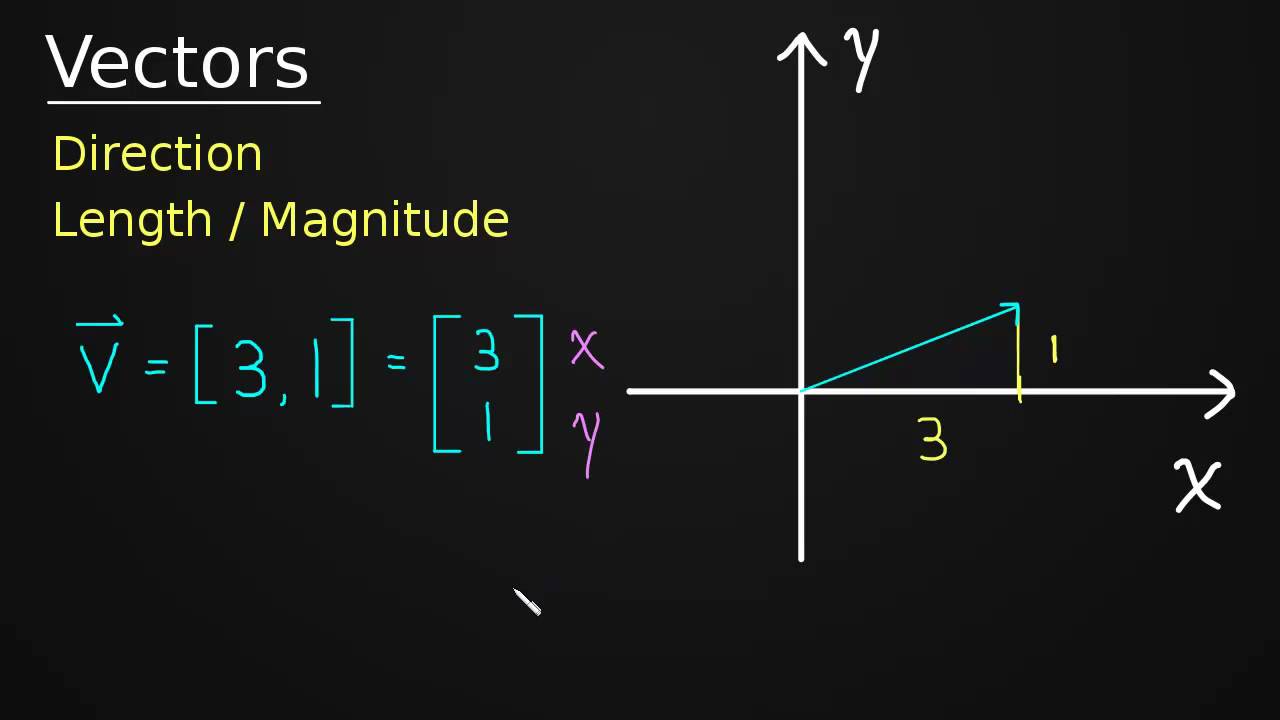
In coordinate geometry, a vector is usually written with components. In two dimensions:
\[ \vec a = \langle a_1,a_2\rangle \]
In three dimensions:
\[ \vec a = \langle a_1,a_2,a_3\rangle \]
The first component measures movement in the \(x\)-direction, the second component measures movement in the \(y\)-direction, and the third component measures movement in the \(z\)-direction. For example, \( \vec a=\langle3,4\rangle \) means move \(3\) units horizontally and \(4\) units vertically. The vector does not have to begin at the origin; it can be translated anywhere without changing its magnitude or direction.
Vector Notation
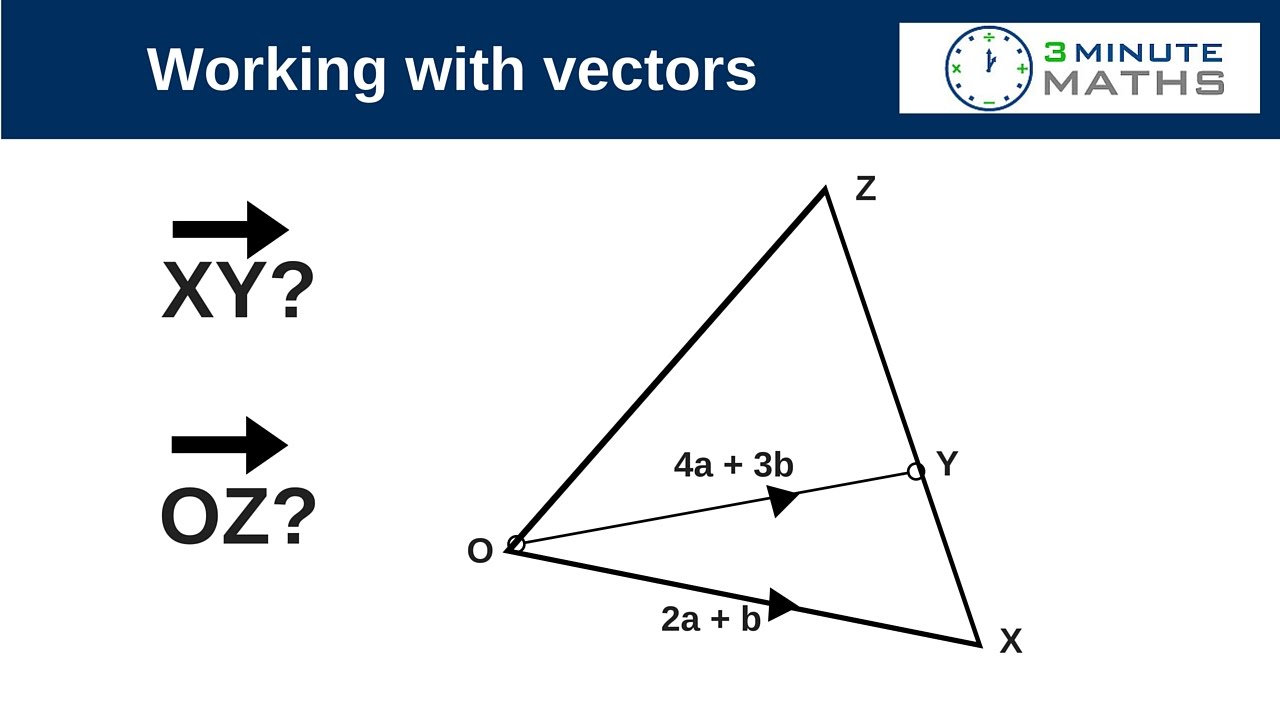
Students meet several forms of vector notation. A vector may be written as \( \vec a \), \( \mathbf{a} \), \( \overrightarrow{AB} \), or in component form. If a vector starts at point \(A\) and ends at point \(B\), it may be written as:
\[ \overrightarrow{AB} = \vec b-\vec a \]
where \( \vec a \) is the position vector of \(A\), and \( \vec b \) is the position vector of \(B\). If \(A(x_1,y_1)\) and \(B(x_2,y_2)\), then:
\[ \overrightarrow{AB} = \langle x_2-x_1,\;y_2-y_1\rangle \]
In three dimensions, if \(A(x_1,y_1,z_1)\) and \(B(x_2,y_2,z_2)\), then:
\[ \overrightarrow{AB} = \langle x_2-x_1,\;y_2-y_1,\;z_2-z_1\rangle \]
Vector Formula Bank
The following formula bank collects the most useful vector formulas for revision. Learn the meaning of each formula instead of memorizing it mechanically. In exam questions, the challenge is often recognizing which formula fits the geometry of the problem.
| Skill | Formula | Meaning |
|---|---|---|
| Vector from \(A\) to \(B\) | \(\overrightarrow{AB}=\langle x_2-x_1,\;y_2-y_1,\;z_2-z_1\rangle\) | Subtract start coordinates from end coordinates. |
| Magnitude | \(|\vec a|=\sqrt{a_1^2+a_2^2+a_3^2}\) | The length of the vector. |
| Unit vector | \(\hat a=\dfrac{\vec a}{|\vec a|}\) | A vector with length \(1\) in the same direction as \(\vec a\). |
| Addition | \(\vec a+\vec b=\langle a_1+b_1,\;a_2+b_2,\;a_3+b_3\rangle\) | Add matching components. |
| Subtraction | \(\vec a-\vec b=\langle a_1-b_1,\;a_2-b_2,\;a_3-b_3\rangle\) | Subtract matching components. |
| Scalar multiplication | \(k\vec a=\langle ka_1,\;ka_2,\;ka_3\rangle\) | Changes vector length and possibly direction. |
| Dot product | \(\vec a\cdot\vec b=a_1b_1+a_2b_2+a_3b_3\) | Measures directional alignment. |
| Angle formula | \(\cos\theta=\dfrac{\vec a\cdot\vec b}{|\vec a||\vec b|}\) | Finds the angle between two non-zero vectors. |
| Projection | \(\operatorname{proj}_{\vec b}\vec a=\dfrac{\vec a\cdot\vec b}{|\vec b|^2}\vec b\) | Part of \(\vec a\) in the direction of \(\vec b\). |
| Cross product | \(\vec a\times\vec b=\langle a_2b_3-a_3b_2,\;a_3b_1-a_1b_3,\;a_1b_2-a_2b_1\rangle\) | Produces a vector perpendicular to both \(\vec a\) and \(\vec b\). |
| Area of parallelogram | \(\text{Area}=|\vec a\times\vec b|\) | Area formed by two adjacent vector sides. |
| Area of triangle | \(\text{Area}=\dfrac{1}{2}|\vec a\times\vec b|\) | Half the corresponding parallelogram area. |
| Vector line | \(\vec r=\vec a+\lambda\vec d\) | A line through point \(\vec a\) in direction \(\vec d\). |
Magnitude of a Vector
The magnitude of a vector is its length. For a two-dimensional vector \( \vec a=\langle a_1,a_2\rangle \), the magnitude comes from Pythagoras' theorem:
\[ |\vec a|=\sqrt{a_1^2+a_2^2} \]
For a three-dimensional vector \( \vec a=\langle a_1,a_2,a_3\rangle \), the formula extends naturally:
\[ |\vec a|=\sqrt{a_1^2+a_2^2+a_3^2} \]
Example: if \( \vec a=\langle3,4\rangle \), then:
\[ |\vec a|=\sqrt{3^2+4^2}=\sqrt{9+16}=5 \]
This tells us that the vector arrow has length \(5\), even though its horizontal and vertical changes are \(3\) and \(4\). A common mistake is to add the components and say the length is \(7\). That is wrong because the components form perpendicular directions, so the length must be found using the square root of the sum of squares.
Unit Vectors
A unit vector is a vector with magnitude \(1\). Unit vectors are useful when you only want direction, not length. To turn a non-zero vector into a unit vector, divide it by its magnitude:
\[ \hat a=\frac{\vec a}{|\vec a|} \]
If \( \vec a=\langle3,4\rangle \), then \( |\vec a|=5 \). Therefore:
\[ \hat a=\left\langle\frac{3}{5},\frac{4}{5}\right\rangle \]
Check that this really has length \(1\):
\[ \left|\left\langle\frac{3}{5},\frac{4}{5}\right\rangle\right|=\sqrt{\left(\frac{3}{5}\right)^2+\left(\frac{4}{5}\right)^2}=\sqrt{\frac{9}{25}+\frac{16}{25}}=1 \]
Vector Addition and Subtraction
Vector addition is performed component by component. If:
\[ \vec a=\langle a_1,a_2,a_3\rangle,\quad \vec b=\langle b_1,b_2,b_3\rangle \]
then:
\[ \vec a+\vec b=\langle a_1+b_1,\;a_2+b_2,\;a_3+b_3\rangle \]
Geometrically, vector addition can be understood using the tip-to-tail method. Place the tail of \( \vec b \) at the tip of \( \vec a \). The resultant vector \( \vec a+\vec b \) runs from the start of \( \vec a \) to the end of \( \vec b \). This is why vector addition is often used for total displacement. If a person walks \(3\) units east and \(4\) units north, their final displacement is not \(7\) units along a straight line; the components combine into a vector.
Subtraction means adding the opposite vector:
\[ \vec a-\vec b=\vec a+(-\vec b) \]
In component form:
\[ \vec a-\vec b=\langle a_1-b_1,\;a_2-b_2,\;a_3-b_3\rangle \]
Scalar Multiplication
A scalar is an ordinary number. Multiplying a vector by a scalar changes the magnitude of the vector. If \(k\) is positive, the direction stays the same. If \(k\) is negative, the vector reverses direction. If \(0<k<1\), the vector becomes shorter. If \(k>1\), the vector becomes longer.
\[ k\vec a=\langle ka_1,ka_2,ka_3\rangle \]
Example:
\[ 2\langle3,-1,4\rangle=\langle6,-2,8\rangle \]
and:
\[ -3\langle2,5\rangle=\langle-6,-15\rangle \]
Dot Product
The dot product, also called the scalar product, takes two vectors and returns a scalar. For:
\[ \vec a=\langle a_1,a_2,a_3\rangle,\quad \vec b=\langle b_1,b_2,b_3\rangle \]
the dot product is:
\[ \vec a\cdot\vec b=a_1b_1+a_2b_2+a_3b_3 \]
The dot product has a powerful geometric meaning:
\[ \vec a\cdot\vec b=|\vec a||\vec b|\cos\theta \]
where \( \theta \) is the angle between the two vectors. If the dot product is positive, the angle is acute. If the dot product is negative, the angle is obtuse. If the dot product is \(0\), the vectors are perpendicular, provided neither vector is the zero vector.
To find the angle between two non-zero vectors, rearrange the formula:
\[ \cos\theta=\frac{\vec a\cdot\vec b}{|\vec a||\vec b|} \]
\[ \theta=\cos^{-1}\left(\frac{\vec a\cdot\vec b}{|\vec a||\vec b|}\right) \]
Vector Projection
Projection answers this question: “How much of one vector points in the direction of another vector?” The vector projection of \( \vec a \) onto \( \vec b \) is:
\[ \operatorname{proj}_{\vec b}\vec a=\frac{\vec a\cdot\vec b}{|\vec b|^2}\vec b \]
The scalar projection is:
\[ \operatorname{comp}_{\vec b}\vec a=\frac{\vec a\cdot\vec b}{|\vec b|} \]
Projection is used in mechanics, work done by a force, shadows in geometry, vector decomposition, computer graphics, and optimization. For example, if a force is applied at an angle, only the component of force in the direction of motion contributes to work along that line.
Cross Product
The cross product takes two three-dimensional vectors and returns a new vector perpendicular to both of them. For:
\[ \vec a=\langle a_1,a_2,a_3\rangle,\quad \vec b=\langle b_1,b_2,b_3\rangle \]
the cross product is:
\[ \vec a\times\vec b=\langle a_2b_3-a_3b_2,\;a_3b_1-a_1b_3,\;a_1b_2-a_2b_1\rangle \]
The magnitude of the cross product is:
\[ |\vec a\times\vec b|=|\vec a||\vec b|\sin\theta \]
This magnitude gives the area of the parallelogram formed by the two vectors:
\[ \text{Area of parallelogram}=|\vec a\times\vec b| \]
The area of the triangle formed by the same two vectors is half of that:
\[ \text{Area of triangle}=\frac{1}{2}|\vec a\times\vec b| \]
The cross product is also a test for parallel vectors. If:
\[ \vec a\times\vec b=\vec 0 \]
then the two non-zero vectors are parallel. This is because the angle between parallel vectors is either \(0^\circ\) or \(180^\circ\), and \( \sin0^\circ=\sin180^\circ=0 \).
Vector Equations of Lines
A line can be described using a point and a direction vector. The standard vector form is:
\[ \vec r=\vec a+\lambda\vec d \]
Here \( \vec r \) is the general position vector of any point on the line, \( \vec a \) is a known point on the line, \( \vec d \) is the direction vector, and \( \lambda \) is a real parameter.
If a line passes through two points \(A\) and \(B\), its direction vector can be found using:
\[ \vec d=\overrightarrow{AB}=\vec b-\vec a \]
Then the line can be written as:
\[ \vec r=\vec a+\lambda(\vec b-\vec a) \]
Example: suppose \(A(1,2,3)\) and \(B(4,0,5)\). Then:
\[ \overrightarrow{AB}=\langle4-1,\;0-2,\;5-3\rangle=\langle3,-2,2\rangle \]
So the vector equation of the line is:
\[ \vec r=\langle1,2,3\rangle+\lambda\langle3,-2,2\rangle \]
The parametric form is:
\[ x=1+3\lambda,\quad y=2-2\lambda,\quad z=3+2\lambda \]
Parallel and Perpendicular Vectors
Two non-zero vectors are parallel if one is a scalar multiple of the other:
\[ \vec a=k\vec b \]
In component form, this means their corresponding components are in the same ratio. For example:
\[ \langle6,9\rangle=3\langle2,3\rangle \]
Therefore \( \langle6,9\rangle \) and \( \langle2,3\rangle \) are parallel.
Two non-zero vectors are perpendicular if their dot product is zero:
\[ \vec a\cdot\vec b=0 \]
Example:
\[ \langle2,3\rangle\cdot\langle3,-2\rangle=2(3)+3(-2)=6-6=0 \]
So the vectors are perpendicular.
Direction Cosines in 3D
Direction cosines describe the angles a vector makes with the coordinate axes. For a non-zero vector:
\[ \vec a=\langle a_1,a_2,a_3\rangle \]
the direction cosines are:
\[ \cos\alpha=\frac{a_1}{|\vec a|},\quad \cos\beta=\frac{a_2}{|\vec a|},\quad \cos\gamma=\frac{a_3}{|\vec a|} \]
where \( \alpha \), \( \beta \), and \( \gamma \) are the angles with the positive \(x\)-, \(y\)-, and \(z\)-axes respectively. These values are useful in 3D geometry, physics, and computer graphics because they describe direction relative to the coordinate system.
Worked Example 1: Magnitude and Unit Vector
Given:
\[ \vec a=\langle6,8\rangle \]
Find \( |\vec a| \):
\[ |\vec a|=\sqrt{6^2+8^2}=\sqrt{36+64}=10 \]
The unit vector in the direction of \( \vec a \) is:
\[ \hat a=\frac{\vec a}{|\vec a|}=\left\langle\frac{6}{10},\frac{8}{10}\right\rangle=\left\langle\frac{3}{5},\frac{4}{5}\right\rangle \]
Worked Example 2: Dot Product and Angle
Given:
\[ \vec a=\langle2,1,2\rangle,\quad \vec b=\langle1,3,-1\rangle \]
First calculate the dot product:
\[ \vec a\cdot\vec b=2(1)+1(3)+2(-1)=2+3-2=3 \]
Next find the magnitudes:
\[ |\vec a|=\sqrt{2^2+1^2+2^2}=3 \]
\[ |\vec b|=\sqrt{1^2+3^2+(-1)^2}=\sqrt{11} \]
Use the angle formula:
\[ \cos\theta=\frac{3}{3\sqrt{11}}=\frac{1}{\sqrt{11}} \]
Therefore:
\[ \theta=\cos^{-1}\left(\frac{1}{\sqrt{11}}\right) \]
A calculator gives approximately:
\[ \theta\approx72.45^\circ \]
Worked Example 3: Projection
Given:
\[ \vec a=\langle5,2\rangle,\quad \vec b=\langle3,1\rangle \]
Find:
\[ \operatorname{proj}_{\vec b}\vec a \]
First calculate:
\[ \vec a\cdot\vec b=5(3)+2(1)=17 \]
and:
\[ |\vec b|^2=3^2+1^2=10 \]
Therefore:
\[ \operatorname{proj}_{\vec b}\vec a=\frac{17}{10}\langle3,1\rangle=\left\langle\frac{51}{10},\frac{17}{10}\right\rangle \]
Worked Example 4: Area of a Triangle
Suppose a triangle has two side vectors:
\[ \vec a=\langle2,1,0\rangle,\quad \vec b=\langle1,4,0\rangle \]
First find the cross product:
\[ \vec a\times\vec b=\langle0,0,2(4)-1(1)\rangle=\langle0,0,7\rangle \]
The parallelogram area is:
\[ |\vec a\times\vec b|=7 \]
The triangle area is:
\[ \frac{1}{2}\times7=\frac{7}{2} \]
Applications of Vectors
Vectors are not just a classroom topic. They are one of the main languages of applied mathematics. In physics, vectors describe velocity, acceleration, force, momentum, electric fields, magnetic fields, and displacement. In engineering, vectors help model loads, stresses, motion, navigation, and design geometry. In computer graphics, vectors control camera direction, lighting, surface normals, collision detection, and animation. In robotics, vectors describe movement, joint positions, paths, and sensor directions. In economics and data science, vectors can represent features, quantities, states, and directions of change.
This is why working with vectors is a high-value skill. Once you understand that a vector is a structured way to store direction and magnitude, many advanced topics become easier. Matrices transform vectors. Calculus studies vector-valued motion. Linear algebra studies vector spaces. Machine learning represents data as high-dimensional vectors. Physics represents forces and fields through vector models. A strong vector foundation supports all of these later topics.
Common Mistakes When Working with Vectors
| Mistake | Why it is wrong | Correct approach |
|---|---|---|
| Adding components to find magnitude | The components are perpendicular, so simple addition does not give length. | Use \( |\vec a|=\sqrt{a_1^2+a_2^2+a_3^2} \). |
| Forgetting that dot product gives a scalar | \(\vec a\cdot\vec b\) is not a vector. | Write the final dot product as a number. |
| Using the angle formula with the zero vector | The denominator contains \( |\vec a||\vec b| \), which becomes zero. | Check both magnitudes first. |
| Confusing \( \vec a-\vec b \) with \( \vec b-\vec a \) | Subtraction reverses direction. | For \( \overrightarrow{AB} \), always use end minus start. |
| Forgetting the parameter in a line equation | A line needs infinitely many points. | Use \( \vec r=\vec a+\lambda\vec d \), where \( \lambda\in\mathbb{R} \). |
| Mixing exact and decimal answers too early | Rounding early can change final accuracy. | Keep exact forms until the final step where possible. |
IB Mathematics Course and Assessment Guide for Vectors
In the Diploma Programme, Mathematics: analysis and approaches and Mathematics: applications and interpretation are both available at Standard Level and Higher Level. The current DP mathematics courses became available from August 2019 with first assessment in May 2021. IB also lists a new Mathematics: analysis and approaches course update with launch in February 2027, first teaching in August 2027, and first assessment in May 2029. This means students should always confirm with their teacher whether they are following the current guide or preparing for the updated cycle.
Vectors belong naturally to geometry and trigonometry because they connect coordinate movement, length, direction, angle, lines, and spatial reasoning. For Mathematics: analysis and approaches, vectors also support proof and exact algebraic reasoning. A typical vector question may ask you to show that points are collinear, prove that two lines intersect, calculate an angle, find a point using a ratio, form a vector equation, or interpret a geometric situation using a diagram.
IB Mathematics AA assessment snapshot
| Level | Component | Technology | Duration | Weighting | Vector relevance |
|---|---|---|---|---|---|
| SL | Paper 1 | No technology | 1 hour 30 minutes | 40% | Exact vector calculations, proofs, angle formulas, algebraic reasoning. |
| SL | Paper 2 | Technology allowed | 1 hour 30 minutes | 40% | Vector geometry, coordinate models, numerical interpretation. |
| SL | Mathematical exploration | Appropriate technology allowed | Coursework | 20% | Useful for modelling displacement, forces, routes, geometry, and data representations. |
| HL | Paper 1 | No technology | 2 hours | 30% | Deeper vector manipulation, exact work, proof, and multi-step reasoning. |
| HL | Paper 2 | Technology allowed | 2 hours | 30% | Complex vector geometry, modelling, numerical checking, and interpretation. |
| HL | Paper 3 | Technology allowed | 1 hour | 20% | Problem-solving, investigation, unfamiliar contexts, and connected reasoning. |
| HL | Mathematical exploration | Appropriate technology allowed | Coursework | 20% | Useful for vector modelling in physics, graphics, optimization, and geometry. |
Score guidelines and grade descriptor summary
IB subject grades are awarded on a scale from \(1\) to \(7\), with \(7\) being the highest. Grade boundaries are not fixed universal percentages; they are determined using assessment evidence and grade descriptors for each session and component. For this reason, it is better to study the descriptor qualities than to rely on a guessed percentage boundary.
| IB grade | Practical meaning for vector work | What to show in answers |
|---|---|---|
| 7 | Comprehensive understanding, sophisticated reasoning, strong problem solving in unfamiliar contexts. | Clear notation, correct formulas, precise arguments, efficient methods, strong interpretation. |
| 6 | Broad and accurate understanding with successful reasoning in varied contexts. | Correct vector operations, mostly complete explanations, sound use of technology when allowed. |
| 5 | Good understanding and effective routine problem solving. | Mostly correct calculations, appropriate notation, some explanation of significance. |
| 4 | Satisfactory knowledge with success in straightforward contexts. | Basic formulas applied correctly, some reasoning, adequate communication. |
| 3 | Partial knowledge and limited understanding. | Some correct routine processes but gaps in reasoning, notation, or interpretation. |
| 2 | Limited knowledge and basic processes only. | Fragments of correct working; frequent notation or method errors. |
| 1 | Minimal knowledge of the syllabus. | Little consistent vector method or communication. |
Upcoming 2026 IB Mathematics AA exam timetable snapshot
The schedule below is a helpful revision-planning snapshot for Mathematics: analysis and approaches. It is not a substitute for your school coordinator's official exam notice. Schools follow allocated exam zones and local start-time rules, so students should always confirm the final time with their IB coordinator.
| Session | Paper | Date | Session | Duration |
|---|---|---|---|---|
| May 2026 | Mathematics: analysis and approaches HL/SL Paper 1 | Thursday 14 May 2026 | Afternoon | HL 2h, SL 1h 30m |
| May 2026 | Mathematics: analysis and approaches HL/SL Paper 2 | Friday 15 May 2026 | Morning | HL 2h, SL 1h 30m |
| May 2026 | Mathematics: analysis and approaches HL Paper 3 | Wednesday 20 May 2026 | Afternoon | 1h 15m in the published schedule |
| November 2026 | Mathematics: analysis and approaches HL/SL Paper 1 | Monday 9 November 2026 | Afternoon | HL 2h, SL 1h 30m |
| November 2026 | Mathematics: analysis and approaches HL/SL Paper 2 | Tuesday 10 November 2026 | Morning | HL 2h, SL 1h 30m |
| November 2026 | Mathematics: analysis and approaches HL Paper 3 | Friday 13 November 2026 | Afternoon | 1h 15m in the published schedule |
How to Study Vectors Efficiently
A good vector revision plan should move from simple component operations to geometric interpretation. Start with notation and magnitude. Then learn addition, subtraction, scalar multiplication, and position vectors. Once these are comfortable, move to the dot product and angle problems. After that, study projection and vector line equations. Finally, practise mixed questions where the question does not tell you which formula to use.
For exam preparation, do not study vectors by only reading solutions. You need to write full solutions yourself. Use correct notation every time. State the formula, substitute values, simplify carefully, and interpret the result. If the question asks you to “show that,” avoid relying only on decimal values; use exact algebra wherever possible.
Day 1
Revise vector notation, position vectors, displacement, magnitude, and unit vectors.
Day 2
Practise addition, subtraction, scalar multiplication, and geometric interpretation.
Day 3
Focus on dot product, perpendicularity, and angle between vectors.
Day 4
Study projection, vector lines, intersections, and exam-style reasoning.
Day 5
Attempt mixed vector questions under timed conditions and review mistakes.
Practice Questions
- Find the magnitude of \( \vec a=\langle7,24\rangle \).
- Find the unit vector in the direction of \( \vec b=\langle-6,8\rangle \).
- Calculate \( \langle3,5,-1\rangle+\langle2,-4,6\rangle \).
- Calculate \( 4\langle2,-3,5\rangle \).
- Find \( \vec a\cdot\vec b \) for \( \vec a=\langle1,2,3\rangle \) and \( \vec b=\langle4,-1,2\rangle \).
- Show whether \( \langle2,5\rangle \) and \( \langle10,25\rangle \) are parallel.
- Show whether \( \langle4,-3\rangle \) and \( \langle6,8\rangle \) are perpendicular.
- Find the vector from \(A(2,-1,4)\) to \(B(7,3,-2)\).
- Find the angle between \( \vec a=\langle1,0,1\rangle \) and \( \vec b=\langle0,1,1\rangle \).
- Write the vector equation of the line through \(A(1,2,0)\) and \(B(3,-1,4)\).
Answers
- \( |\vec a|=\sqrt{7^2+24^2}=25 \)
- \( \hat b=\left\langle-\frac{3}{5},\frac{4}{5}\right\rangle \)
- \( \langle5,1,5\rangle \)
- \( \langle8,-12,20\rangle \)
- \( 1(4)+2(-1)+3(2)=8 \)
- Yes, because \( \langle10,25\rangle=5\langle2,5\rangle \).
- Yes, because \( \langle4,-3\rangle\cdot\langle6,8\rangle=24-24=0 \).
- \( \overrightarrow{AB}=\langle5,4,-6\rangle \)
- \( \cos\theta=\frac{1}{2} \), so \( \theta=60^\circ \).
- \( \vec r=\langle1,2,0\rangle+\lambda\langle2,-3,4\rangle \)
Frequently Asked Questions
What is a vector in mathematics?
A vector is a quantity with both magnitude and direction. It can be represented geometrically as an arrow or algebraically using components such as \( \langle3,4\rangle \).
What is the difference between a scalar and a vector?
A scalar has size only, while a vector has size and direction. Temperature and mass are scalar quantities. Velocity, force, displacement, and acceleration are vector quantities.
How do you find the magnitude of a vector?
Use the square root of the sum of the squared components. For \( \vec a=\langle a_1,a_2,a_3\rangle \), the magnitude is \( |\vec a|=\sqrt{a_1^2+a_2^2+a_3^2} \).
How do you add two vectors?
Add matching components. If \( \vec a=\langle a_1,a_2\rangle \) and \( \vec b=\langle b_1,b_2\rangle \), then \( \vec a+\vec b=\langle a_1+b_1,a_2+b_2\rangle \).
What does the dot product tell you?
The dot product measures how much two vectors point in the same direction. It is also used to find the angle between vectors and to test perpendicularity.
When are two vectors perpendicular?
Two non-zero vectors are perpendicular when their dot product is zero: \( \vec a\cdot\vec b=0 \).
When are two vectors parallel?
Two non-zero vectors are parallel if one is a scalar multiple of the other. In 3D, parallel vectors also have a zero cross product.
What is a unit vector?
A unit vector has length \(1\). It is found by dividing a non-zero vector by its magnitude: \( \hat a=\frac{\vec a}{|\vec a|} \).
What is the vector equation of a line?
The vector equation of a line is \( \vec r=\vec a+\lambda\vec d \), where \( \vec a \) is a point on the line, \( \vec d \) is the direction vector, and \( \lambda \) is a real parameter.
Are vectors important for IB Mathematics?
Yes. Vectors connect algebra, geometry, trigonometry, and modelling. They can appear in questions involving magnitude, direction, angles, lines, proof, and coordinate geometry.
Conclusion
Working with vectors is one of the most useful skills in modern mathematics. Vectors allow students to describe movement, length, direction, angle, position, force, and geometric structure using a compact algebraic language. The core techniques are straightforward: subtract coordinates to form displacement vectors, use Pythagoras to find magnitude, divide by magnitude to find a unit vector, add and subtract components carefully, use the dot product for angles and perpendicularity, use projection for directional components, and use vector equations to describe lines.
For exam success, the most important habit is not just knowing formulas but choosing the correct formula for the situation. Always define vectors clearly, use exact notation, check whether vectors are zero before using angle or unit-vector formulas, interpret your result in the context of the question, and practise mixed problems. Vectors are the bridge between visual geometry and algebraic proof; once you master them, many advanced topics become easier.