Kilocalories to Calories (cal) Converter
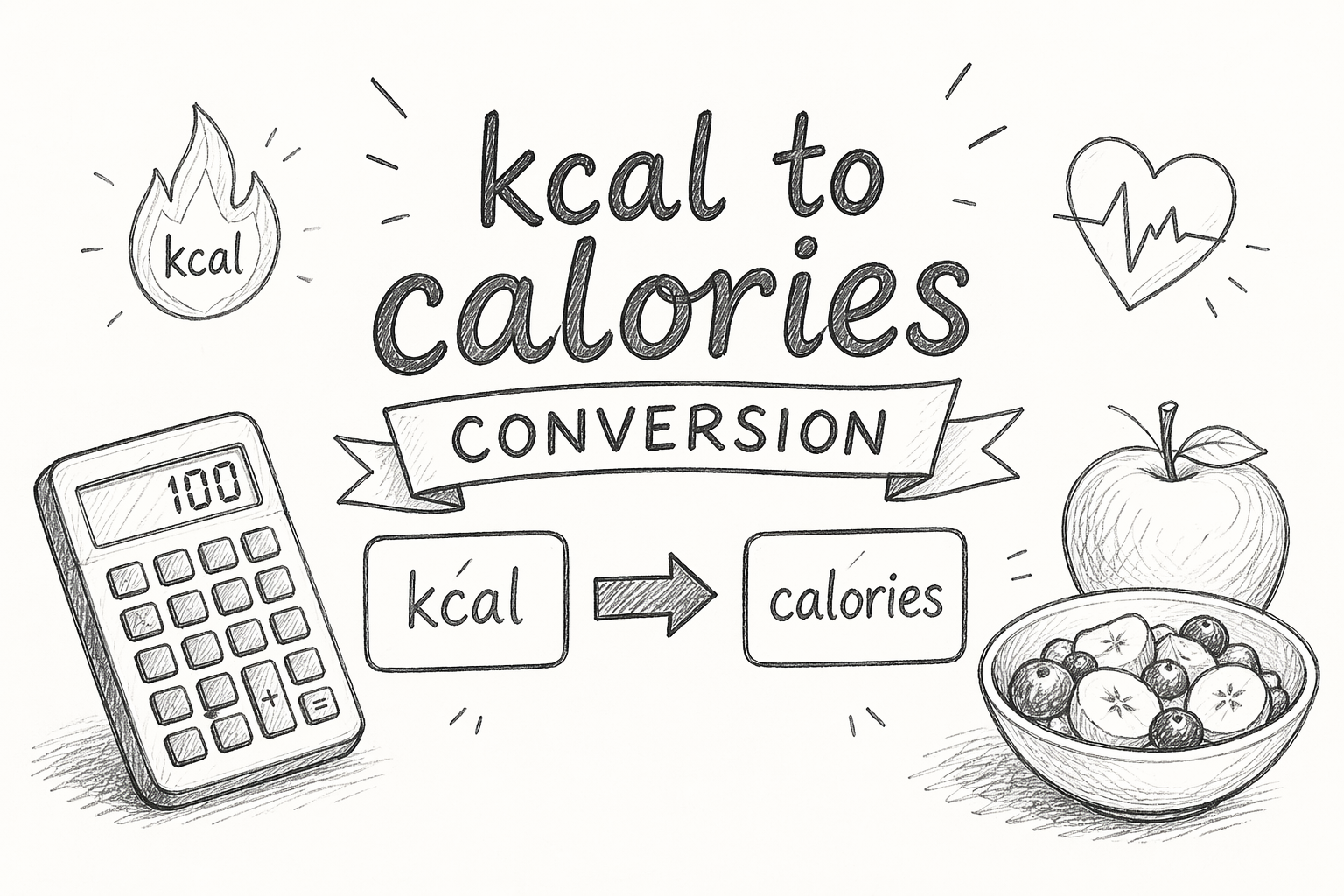
Convert kilocalories (kcal) to calories (cal) instantly with our accurate energy conversion calculator for nutrition, fitness, and scientific applications.
Online Calculator
Understanding Kilocalories and Calories
Energy measurement involves understanding the relationship between kilocalories and calories, two units that measure the same physical property but at different scales. A kilocalorie (kcal), also known as a large Calorie (capital C) or food calorie, represents the amount of energy required to raise the temperature of one kilogram of water by one degree Celsius at standard atmospheric pressure. This unit dominates nutritional contexts worldwide because it provides convenient numbers for expressing food energy content.
A calorie (with lowercase 'c'), also called a gram calorie or small calorie, represents the energy needed to raise just one gram of water by one degree Celsius. Since one kilogram contains exactly 1,000 grams, one kilocalorie equals exactly 1,000 small calories. This relationship follows standard metric system conventions where the prefix "kilo" universally means one thousand. In scientific and technical contexts, particularly in chemistry and physics, small calories provide the appropriate scale for molecular and atomic energy calculations.
The terminology can create confusion because nutrition labels use "Calories" (with capital C) when they actually mean kilocalories. When a food package states 150 Calories, it means 150 kilocalories or 150,000 small calories. This standardization emerged to simplify consumer understanding and avoid unwieldy six-digit numbers on food packaging. Understanding this distinction proves essential for anyone working in nutrition science, dietetics, exercise physiology, or related health fields.
Conversion Formulas
Kilocalories to Calories
To convert from kilocalories to calories, multiply the kilocalorie value by 1,000:
Example: Convert 3.5 kilocalories to calories
\( \text{cal} = 3.5 \times 1000 = 3500 \text{ cal} \)
Calories to Kilocalories
To convert from calories to kilocalories, divide the calorie value by 1,000:
Example: Convert 8,000 calories to kilocalories
\( \text{kcal} = \frac{8000}{1000} = 8 \text{ kcal} \)
Quick Reference Table
| Kilocalories (kcal) | Calories (cal) |
|---|---|
| 0.1 kcal | 100 cal |
| 0.5 kcal | 500 cal |
| 1 kcal | 1,000 cal |
| 2 kcal | 2,000 cal |
| 5 kcal | 5,000 cal |
| 10 kcal | 10,000 cal |
| 20 kcal | 20,000 cal |
| 50 kcal | 50,000 cal |
| 100 kcal | 100,000 cal |
| 500 kcal | 500,000 cal |
How to Convert Kilocalories to Calories
Converting kilocalories to calories requires understanding the fundamental metric relationship and applying a simple multiplication operation that scales the energy value appropriately.
Step 1: Identify Your Kilocalorie Value
Begin by determining the exact kilocalorie value you need to convert. This figure typically appears on food nutrition labels, daily caloric intake recommendations, exercise energy expenditure data, or metabolic rate calculations. Food labels in most countries display energy in kilocalories (sometimes written as kcal or Calories with capital C), making this the starting point for most conversions.
Step 2: Apply the Conversion Formula
Use the standard conversion formula by multiplying your kilocalorie value by 1,000. This mathematical operation reflects the metric prefix "kilo," which universally represents 1,000 base units across all measurement systems. The formula \( \text{cal} = \text{kcal} \times 1000 \) applies consistently regardless of whether you're converting fractional or whole number values, ensuring accuracy across all magnitudes.
Step 3: Calculate the Result
Perform the multiplication operation to obtain your result in small calories. For instance, if you have 4.75 kilocalories and apply the formula: \( \text{cal} = 4.75 \times 1000 = 4750 \text{ cal} \). The resulting number will always be 1,000 times larger than your input, which reflects the true energy value expressed in smaller units. This larger number reveals why kilocalories are preferred in nutrition contexts.
Step 4: Verify Your Calculation
Double-check your calculation by performing the reverse operation. Divide your calorie result by 1,000 to confirm it matches your original kilocalorie value. Using our example: \( \frac{4750}{1000} = 4.75 \text{ kcal} \). This verification step catches calculation errors and confirms your understanding of the conversion relationship. Accurate conversions prove essential when comparing energy values from different sources or converting scientific data for practical applications.
Practical Applications
Converting kilocalories to calories serves essential purposes across multiple scientific and practical domains. Chemistry students and researchers working with thermochemical equations often need to convert food energy values from nutrition databases into small calories for calorimetry experiments and heat capacity calculations. Physics laboratories measuring thermal energy at molecular scales require conversion from the macro-scale kilocalorie measurements to the more appropriate small calorie units for precision calculations.
Food scientists developing new products must understand both units when conducting nutritional analysis and complying with international labeling regulations that may specify different unit preferences. Exercise physiologists calculating precise metabolic rates during research studies sometimes need to convert between units when comparing data from different measurement instruments or published research using varying conventions. Biochemistry professionals analyzing cellular metabolism and ATP production pathways work with small calories because molecular energy transactions occur at scales where the smaller unit provides appropriate precision.
Students studying nutrition science, dietetics, or health sciences benefit from understanding this conversion when analyzing scientific literature where both units appear. International collaboration in nutrition research requires converting between units since different countries may favor different conventions. Health professionals creating educational materials for diverse audiences must sometimes present energy information in both units to accommodate different educational backgrounds and regional preferences.
Frequently Asked Questions
How do you convert kcal to calories?
Converting kilocalories to calories involves multiplying the kcal value by 1,000, following the universal metric system convention where "kilo" represents one thousand base units. The formula \( \text{cal} = \text{kcal} \times 1000 \) applies to all positive real numbers. For practical application, 6.25 kilocalories multiplied by 1,000 equals 6,250 calories. This straightforward mathematical relationship ensures accuracy across all scales and contexts.
What is the difference between kcal and cal?
A kilocalorie (kcal) equals exactly 1,000 small calories (cal), representing the same energy quantity at different measurement scales. The kilocalorie measures the energy required to raise one kilogram of water by one degree Celsius, while the small calorie raises only one gram of water by the same temperature increment. In nutritional contexts, food labels use "Calories" (capital C) to mean kilocalories because the larger unit produces manageable numbers for expressing food energy content.
Is 1 kcal equal to 1000 calories?
Yes, precisely. One kilocalorie (1 kcal) equals exactly 1,000 small calories (1,000 cal) by definition. This fixed conversion factor derives from the metric system's use of "kilo" as a prefix meaning one thousand, identical to how one kilometer equals 1,000 meters or one kilogram equals 1,000 grams. This relationship remains constant regardless of temperature, pressure, or the substance being measured, making it a fundamental conversion in energy calculations.
Why do food labels use kcal instead of cal?
Food labels use kilocalories (kcal) because expressing food energy in small calories would produce unwieldy six-digit numbers that confuse consumers. A medium apple containing 95 kcal would show 95,000 calories if small calories were used. Kilocalories provide convenient, manageable numbers that consumers can easily understand and compare. International food labeling standards have adopted kilocalories (or kilojoules) to maintain consistency and prevent consumer confusion across different products and markets.
When should I convert kcal to calories?
Convert kilocalories to small calories when working with scientific calculations in chemistry, physics, or thermodynamics where the smaller unit provides appropriate precision for molecular-scale energy transactions. This conversion proves essential when comparing nutritional data with scientific literature using different unit conventions, conducting calorimetry experiments, or performing heat capacity calculations. Most everyday nutrition and dietary applications use kilocalories exclusively, eliminating the need for conversion in practical health contexts.
Are dietary Calories the same as kcal?
Dietary Calories (written with uppercase C) are exactly the same as kilocalories (kcal) in all nutritional contexts worldwide. When a food package indicates 300 Calories, it means 300 kilocalories or 300,000 small calories. This naming convention emerged to simplify consumer communication while maintaining scientific accuracy. The terms "Calorie," "kcal," "kilocalorie," and "large calorie" all represent identical energy quantities in dietary and nutritional applications, causing frequent confusion but serving the same measurement purpose.
How do kilocalories relate to joules?
Kilocalories relate to joules through the thermochemical conversion factor where one kilocalorie equals approximately 4,184 joules or 4.184 kilojoules (kJ). The joule serves as the International System (SI) unit for energy, making it the scientifically preferred unit, though kilocalories dominate nutritional contexts in many countries. To convert kilocalories to kilojoules, multiply by 4.184; for the reverse conversion, divide kilojoules by 4.184. Many food labels outside the United States display both kilocalories and kilojoules to accommodate different regional preferences.
Key Points to Remember
- ✓ One kilocalorie (kcal) equals exactly 1,000 calories (cal) by metric definition
- ✓ Multiply by 1,000 to convert kilocalories to calories
- ✓ Divide by 1,000 to convert calories to kilocalories
- ✓ Food labels display Calories (capital C) which mean kilocalories
- ✓ Kilocalories provide convenient numbers for nutritional applications
- ✓ Small calories suit scientific contexts and molecular-scale calculations
- ✓ The conversion follows universal metric system standards
Mathematical Relationship
The mathematical relationship between kilocalories and calories forms a simple linear function with a constant multiplication factor. This relationship can be expressed through proportional equations that demonstrate the scaling factor between the two energy units.
General Conversion Equation:
Proportional Relationship:
Algebraic Expression:
This constant ratio means that energy values always scale by exactly 1,000 when converting from kilocalories to calories. Whether converting 0.5 kilocalories or 500 kilocalories, you always multiply by 1,000 to obtain the equivalent calorie measurement. This mathematical consistency eliminates ambiguity and ensures that conversions remain accurate regardless of the magnitude of your initial measurement or the precision required by your application.
Explore More Conversion Tools
Discover RevisionTown's extensive collection of calculators, conversion tools, and educational resources designed to support students, professionals, and lifelong learners in mathematics, science, and nutrition.
Visit RevisionTown