⚡ mW to Watts Converter
Professional Milliwatts to Watts Calculator | Low-Power Electronics Tool
⚡ Common Low-Power Device Ratings
📚 Complete Guide to mW and Watts Conversion
Understanding Milliwatts and Watts
Milliwatts (mW) and watts (W) are SI units measuring electrical power at different scales. 1 watt (W) = 1,000 milliwatts (mW), representing the metric prefix "milli" meaning one-thousandth (1/1,000). Milliwatts measure very low power levels in small electronics and precision devices: LEDs 20-500 mW, laser pointers 1-5 mW (Class 2), laser diodes 5-100 mW, Bluetooth modules 5-10 mW transmission power, WiFi modules 50-200 mW, RF transmitters 10-1,000 mW, IoT sensors 0.1-10 mW active power, smartwatch components 5-50 mW, hearing aids 1-3 mW, optical transceivers 50-500 mW. Watts measure higher power: LED bulbs 5-15 W, smartphones charging 5-20 W, laptops 30-100 W, appliances 100-2,000 W. The milliwatt unit enables precise specification of low-power devices where decimal watts (0.005 W) would be cumbersome. Understanding mW-watt conversion helps electronics engineers specify component power ratings, RF engineers measure signal strength, laser safety officers classify laser hazard levels, IoT developers optimize battery life, and hobbyists select appropriate power supplies for electronic projects.
Conversion Formulas
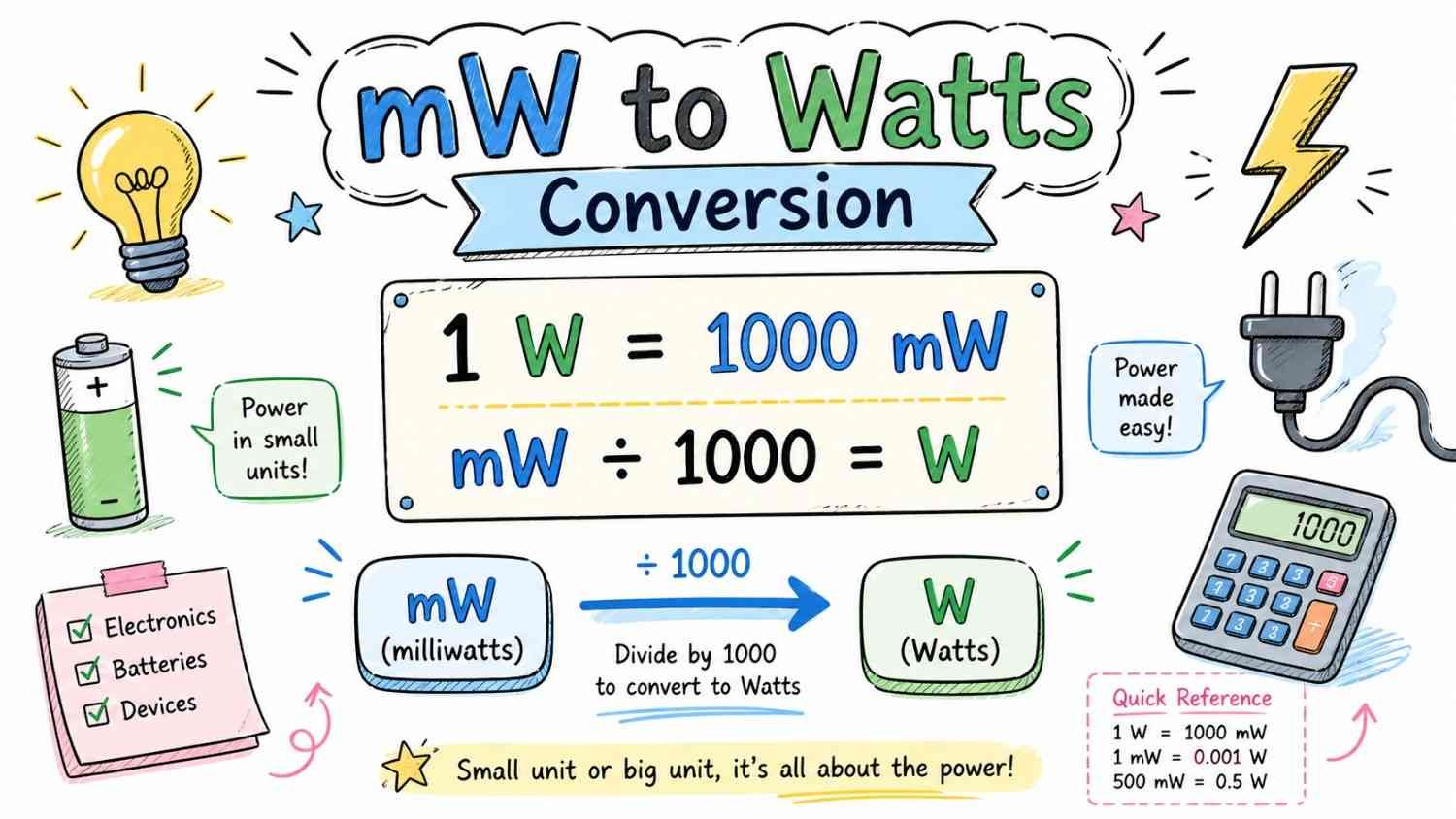
Milliwatts to Watts: \( W = \frac{\text{mW}}{1{,}000} \) or \( W = \text{mW} \times 0.001 \). Divide milliwatts by 1,000 to convert to watts. Examples: 1 mW ÷ 1,000 = 0.001 W (temperature sensor); 5 mW ÷ 1,000 = 0.005 W (Class 2 laser pointer, safe for accidental eye exposure); 10 mW ÷ 1,000 = 0.01 W (Bluetooth Low Energy transmission); 50 mW ÷ 1,000 = 0.05 W (LED indicator light); 100 mW ÷ 1,000 = 0.1 W (WiFi 2.4 GHz module maximum transmission); 250 mW ÷ 1,000 = 0.25 W (high-power LED); 500 mW ÷ 1,000 = 0.5 W (audio amplifier output); 1,000 mW ÷ 1,000 = 1 W (small speaker, USB charger port); 2,000 mW ÷ 1,000 = 2 W (older USB 2.0 charger); 5,000 mW ÷ 1,000 = 5 W (USB Type-A charger, standard smartphone charging); 10,000 mW ÷ 1,000 = 10 W (LED bulb, fast phone charging); 25,000 mW ÷ 1,000 = 25 W (laptop USB-C charging, some tablets). Watts to Milliwatts: \( \text{mW} = W \times 1{,}000 \). Multiply watts by 1,000 to convert to milliwatts. Examples: 0.001 W × 1,000 = 1 mW; 0.005 W × 1,000 = 5 mW; 0.01 W × 1,000 = 10 mW; 0.05 W × 1,000 = 50 mW; 0.1 W × 1,000 = 100 mW; 0.5 W × 1,000 = 500 mW; 1 W × 1,000 = 1,000 mW; 2 W × 1,000 = 2,000 mW; 5 W × 1,000 = 5,000 mW; 10 W × 1,000 = 10,000 mW. This simple 1:1,000 ratio makes conversion straightforward—move the decimal point three places. These conversions enable electronics engineers to match component specifications (datasheet lists 250 mW maximum LED power = 0.25 W for heat dissipation calculations), RF engineers to convert between mW and dBm (dBm = 10 × log₁₀(mW); 100 mW = 20 dBm), and makers to verify power supply capacity (500 mW module requires 0.5 W minimum supply capacity with margin for efficiency losses).
Low-Power Device Comparison Table
| Device / Component | Milliwatts (mW) | Watts (W) | Application |
|---|---|---|---|
| Temperature sensor (active) | 0.1-2 mW | 0.0001-0.002 W | IoT devices, smart home |
| Class 1 laser pointer | < 0.4 mW | < 0.0004 W | Safe laser, no eye hazard |
| Class 2 laser pointer | 0.4-1 mW | 0.0004-0.001 W | Typical red laser pointer |
| Class 3A laser | 1-5 mW | 0.001-0.005 W | Presentation pointer (max 5 mW) |
| Bluetooth LE (transmit) | 5-10 mW | 0.005-0.01 W | Wireless earbuds, fitness trackers |
| ZigBee module | 10-50 mW | 0.01-0.05 W | Smart home mesh network |
| LED indicator (standard) | 20-100 mW | 0.02-0.1 W | Status lights, displays |
| WiFi 2.4 GHz (transmit) | 50-100 mW | 0.05-0.1 W | ESP8266, IoT modules (US limit) |
| LoRa transmitter | 100-200 mW | 0.1-0.2 W | Long-range IoT communication |
| High-power LED | 250-1,000 mW | 0.25-1 W | Flashlights, indicators |
| Cellular modem (2G/3G) | 500-2,000 mW | 0.5-2 W | Peak transmission power |
| Audio amplifier (small) | 500-5,000 mW | 0.5-5 W | Earbuds, small speakers |
| USB 2.0 port output | 2,500 mW | 2.5 W | 5V × 0.5A = 2.5 W max |
| USB 3.0 port output | 4,500 mW | 4.5 W | 5V × 0.9A = 4.5 W max |
| Smartphone charger (standard) | 5,000 mW | 5 W | 5V × 1A basic charging |
| Fast phone charger | 10,000-25,000 mW | 10-25 W | Quick Charge, USB-PD |
RF Power and dBm Conversion
In radio frequency (RF) and telecommunications, power is often expressed in dBm (decibel-milliwatts) requiring conversion between mW and watts. dBm Definition: dBm = 10 × log₁₀(P_mW), where P_mW is power in milliwatts referenced to 1 mW. Reverse: P_mW = 10^(dBm/10). Common RF Power Levels: -30 dBm = 0.001 mW = 0.000001 W (1 μW, weak sensor signal); -20 dBm = 0.01 mW = 0.00001 W (10 μW, typical Bluetooth receive sensitivity); -10 dBm = 0.1 mW = 0.0001 W (100 μW, weak WiFi signal); 0 dBm = 1 mW = 0.001 W (reference level, typical GPS receiver); +10 dBm = 10 mW = 0.01 W (Bluetooth Low Energy max transmission); +13 dBm = 20 mW = 0.02 W (typical WiFi 802.11b/g transmission); +17 dBm = 50 mW = 0.05 W; +20 dBm = 100 mW = 0.1 W (WiFi 2.4 GHz US FCC limit for point-to-multipoint); +23 dBm = 200 mW = 0.2 W; +27 dBm = 500 mW = 0.5 W (WiFi 5 GHz max with restrictions); +30 dBm = 1,000 mW = 1 W (1 watt, CB radio, some amateur radio HTs). Practical Example: WiFi router specification: "Transmit power +20 dBm" = 100 mW = 0.1 W per antenna. With 3 antennas simultaneously transmitting: 3 × 100 mW = 300 mW = 0.3 W total RF output (plus additional power for processing, typically 3-7 W total device consumption). Understanding mW-watt-dBm conversions enables RF engineers to design link budgets, wireless system integrators to plan network coverage, and regulatory compliance officers to verify transmitter power within legal limits (FCC Part 15 for unlicensed ISM band devices specifies maximum transmit power in mW or dBm depending on band and antenna gain).
Why Choose RevisionTown's mW to Watts Converter?
RevisionTown's professional converter provides: (1) Precision for Low Power—Handles fractional milliwatts (0.5 mW) and microwatt-level conversions with full accuracy; (2) Bidirectional Conversion—Convert mW↔watts seamlessly with dedicated tabs optimized for each direction; (3) Scientific Notation Support—Displays very small watt values clearly (1 mW = 0.001 W = 1×10⁻³ W); (4) Bulk Processing—Convert multiple component power ratings simultaneously for circuit design and power budgeting; (5) Quick Reference—Common low-power device ratings from sensors (1 mW) to phone chargers (5,000 mW); (6) Formula Display—View exact calculations for educational and verification purposes; (7) Mobile Optimized—Use on smartphones during electronics assembly, component selection, or datasheet review; (8) Zero Cost—Completely free with no registration or usage limits; (9) Professional Accuracy—Trusted by electronics engineers, RF designers, laser safety officers, IoT developers, makers, students, and hobbyists for component specifications, circuit design, RF link budgets, laser safety classifications, battery life calculations, power supply sizing, and all applications requiring accurate low-power unit conversions for professional electronics work, wireless system design, and precision power measurements worldwide.
❓ Frequently Asked Questions
1 milliwatt equals 0.001 watts (one-thousandth of a watt). Formula: 1 mW = 0.001 W or 1 mW ÷ 1,000 = 0.001 W. Milliwatts measure very low power for small electronics, sensors, laser pointers, and RF signals. Examples: 5 mW = 0.005 W (laser pointer); 10 mW = 0.01 W (Bluetooth); 100 mW = 0.1 W (WiFi module); 1,000 mW = 1 W.
Divide milliwatts by 1,000 or multiply by 0.001. Formula: W = mW ÷ 1,000 or W = mW × 0.001. Examples: 1 mW = 0.001 W; 5 mW = 0.005 W; 10 mW = 0.01 W; 50 mW = 0.05 W; 100 mW = 0.1 W; 500 mW = 0.5 W; 1,000 mW = 1 W; 5,000 mW = 5 W. Reverse (watts to mW): multiply by 1,000. Move decimal three places left (mW→W) or right (W→mW).
mW (milliwatts) and watts both measure power. 1 watt = 1,000 milliwatts (1,000× larger). Milliwatts used for low-power devices: laser pointers 1-5 mW, Bluetooth 5-10 mW, LEDs 20-500 mW, WiFi modules 50-200 mW, sensors 0.1-10 mW. Watts used for higher power: LED bulbs 5-15 W, phone chargers 5-20 W, laptops 30-100 W, appliances 100-2,000 W. Use mW for precision specification of small electronics; watts for everyday devices.
5 watts equals 5,000 milliwatts. Calculation: 5 W × 1,000 = 5,000 mW. This is typical power for USB Type-A chargers (5V × 1A = 5W = 5,000 mW), small LED bulbs, and basic smartphone charging. In RF terms: 5 W = 5,000 mW = +37 dBm (CB radio handheld, amateur radio HT maximum output).
100 milliwatts equals 0.1 watts. Formula: 100 mW ÷ 1,000 = 0.1 W. This is typical for WiFi module transmission power (US FCC limit for 2.4 GHz ISM band point-to-multipoint), LED indicator lights, and small RF transmitters. In dBm: 100 mW = +20 dBm. Common devices: WiFi router per-antenna output, LoRa transmitter, high-brightness LED indicator.
1 watt equals 1,000 milliwatts. Formula: 1 W = 1,000 mW or 1 W × 1,000 = 1,000 mW. This conversion is standard SI metric prefix: "milli" = 1/1,000. Examples: 0.5 W = 500 mW; 1 W = 1,000 mW; 2 W = 2,000 mW; 5 W = 5,000 mW; 10 W = 10,000 mW. 1 watt typical for small speakers, USB charger output, high-power LEDs.
Milliwatt-power devices include: Sensors (0.1-10 mW: temperature, humidity, motion); Lasers (1-5 mW: Class 2/3A laser pointers, safe for brief exposure); Wireless (5-200 mW: Bluetooth 5-10 mW, ZigBee 10-50 mW, WiFi 50-100 mW transmission); LEDs (20-1,000 mW: indicators 20-100 mW, high-power 500-1,000 mW); RF transmitters (10-1,000 mW: IoT radios, LoRa, cellular modems); Audio (500-5,000 mW: earbud amplifiers, small speakers). Low power enables battery operation (coin cells, small lithium batteries) for extended periods.
Formula: dBm = 10 × log₁₀(mW). Examples: 0.001 mW = -30 dBm; 0.01 mW = -20 dBm; 0.1 mW = -10 dBm; 1 mW = 0 dBm (reference); 10 mW = +10 dBm; 100 mW = +20 dBm; 1,000 mW (1 W) = +30 dBm. Reverse (dBm to mW): mW = 10^(dBm/10). Example: +17 dBm = 10^(17/10) = 10^1.7 = 50.1 mW ≈ 50 mW. Used in RF/wireless engineering for signal strength and transmit power specifications.