📡 dBm to mW Converter
Professional RF Power Conversion Tool | Wireless & Telecommunications
📊 Common RF Power Levels
📚 Complete Guide to dBm and Milliwatts Conversion
Understanding dBm and Milliwatts
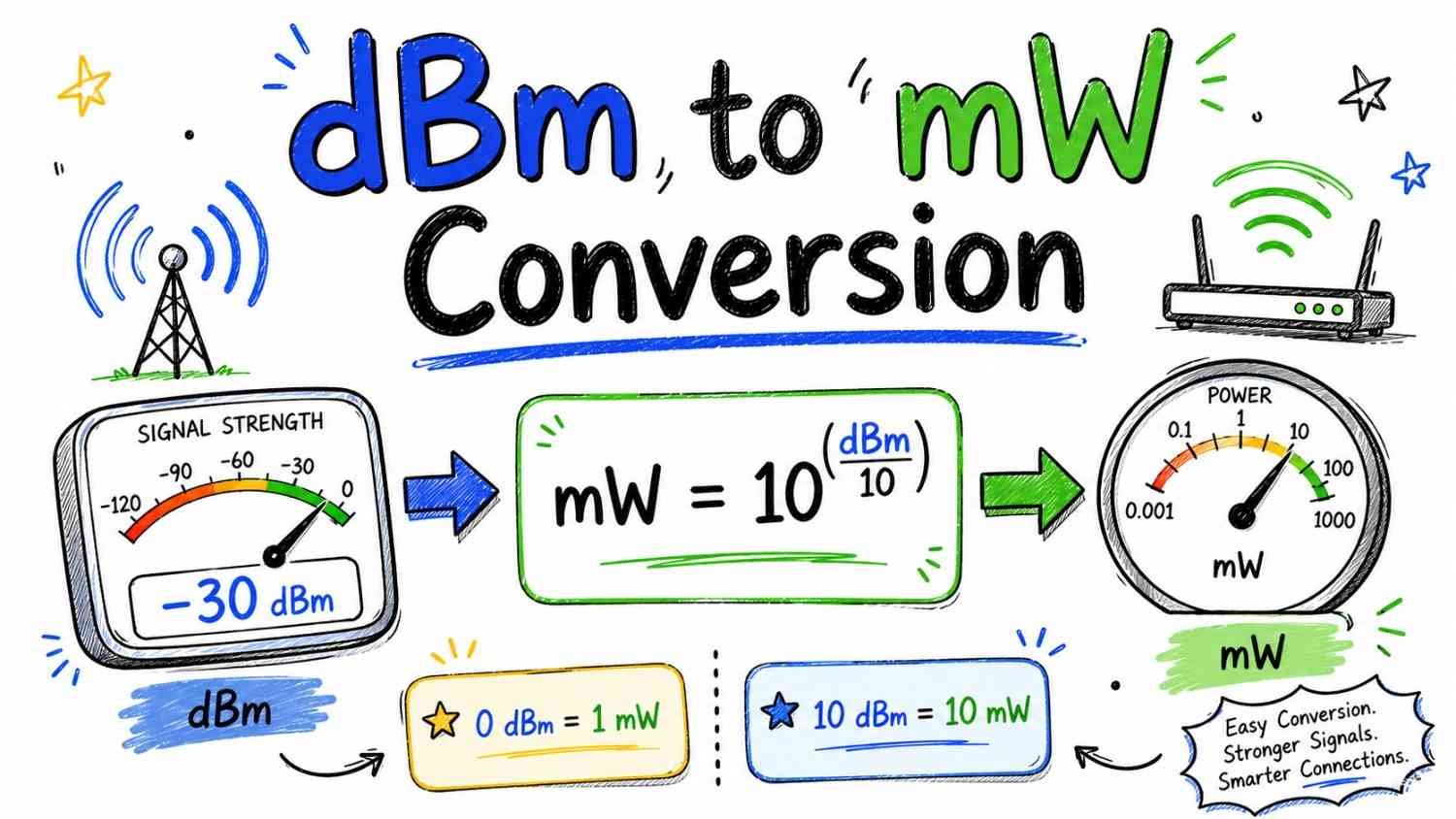
dBm (decibel-milliwatts) is a logarithmic unit expressing absolute RF power relative to 1 milliwatt, universally used in RF engineering, wireless communications, telecommunications, fiber optics, antenna systems, spectrum analysis, and all radio frequency applications. The "dB" indicates a decibel (logarithmic) measurement, while "m" specifies the reference as 1 milliwatt. By fundamental definition, 0 dBm equals exactly 1 milliwatt. Positive dBm values represent power greater than 1 mW (example: 20 dBm = 100 mW); negative dBm values represent power less than 1 mW (example: -20 dBm = 0.01 mW). Milliwatts (mW) are linear power measurements where 1 mW = 0.001 watts or 1/1000th of a watt. The logarithmic dBm scale compresses enormous power ranges spanning 12+ orders of magnitude (picowatts to kilowatts) into manageable numbers typically between -100 dBm and +60 dBm, making it intuitive for RF engineers. Understanding the relationship between logarithmic dBm and linear milliwatts is essential for transmitter specifications (WiFi routers typically output 100-200 mW = 20-23 dBm), receiver sensitivity analysis (requiring microwatts = negative dBm levels), antenna system calculations, link budget analysis, signal strength measurements, spectrum analyzer interpretation, regulatory compliance with power limits, and virtually all wireless system design, deployment, and troubleshooting applications from Bluetooth devices to cellular base stations.
Conversion Formulas
dBm to Milliwatts: \( P_{\text{mW}} = 10^{P_{\text{dBm}}/10} \). This is the direct inverse of the logarithmic dBm definition. To convert: divide the dBm value by 10, then raise 10 to that power. Examples: 0 dBm = 10^(0/10) = 10^0 = 1 mW; 10 dBm = 10^(10/10) = 10^1 = 10 mW; 20 dBm = 10^(20/10) = 10^2 = 100 mW; 30 dBm = 10^(30/10) = 10^3 = 1,000 mW; -10 dBm = 10^(-10/10) = 10^-1 = 0.1 mW; -20 dBm = 10^(-20/10) = 10^-2 = 0.01 mW; -30 dBm = 10^(-30/10) = 10^-3 = 0.001 mW. Milliwatts to dBm: \( P_{\text{dBm}} = 10 \times \log_{10}(P_{\text{mW}}) \). This applies the logarithmic definition of dBm. To convert: take the base-10 logarithm of the milliwatt value, then multiply by 10. Examples: 1 mW = 10 × log₁₀(1) = 10 × 0 = 0 dBm; 10 mW = 10 × log₁₀(10) = 10 × 1 = 10 dBm; 100 mW = 10 × log₁₀(100) = 10 × 2 = 20 dBm; 1,000 mW = 10 × log₁₀(1,000) = 10 × 3 = 30 dBm; 0.1 mW = 10 × log₁₀(0.1) = 10 × (-1) = -10 dBm; 0.01 mW = 10 × log₁₀(0.01) = 10 × (-2) = -20 dBm. These formulas are fundamental to all RF engineering calculations and enable seamless translation between equipment specifications, measurements, and system requirements.
Comprehensive Conversion Table
| dBm | Milliwatts (mW) | Watts (W) | Typical Application |
|---|---|---|---|
| -40 dBm | 0.0001 mW | 0.0000001 W | Receiver sensitivity threshold |
| -30 dBm | 0.001 mW | 0.000001 W | Very weak signal (1 µW) |
| -20 dBm | 0.01 mW | 0.00001 W | Weak WiFi edge signal |
| -10 dBm | 0.1 mW | 0.0001 W | Poor WiFi connection |
| 0 dBm | 1 mW | 0.001 W | Reference level (1 mW) |
| 10 dBm | 10 mW | 0.01 W | Bluetooth transmitter |
| 15 dBm | 31.6 mW | 0.0316 W | WiFi client device |
| 20 dBm | 100 mW | 0.1 W | Low-power WiFi router |
| 23 dBm | 200 mW | 0.2 W | Standard WiFi router |
| 27 dBm | 500 mW | 0.5 W | Cell phone transmit |
| 30 dBm | 1,000 mW | 1 W | Maximum WiFi legal limit |
| 33 dBm | 2,000 mW | 2 W | High-power wireless |
| 40 dBm | 10,000 mW | 10 W | Ham radio transmitter |
WiFi and Wireless Signal Measurements
WiFi systems universally measure signal strength in dBm, requiring conversion to milliwatts for power specifications. Router Output Power: Consumer WiFi routers typically transmit 100-200 mW (20-23 dBm) on 2.4 GHz band and 200-500 mW (23-27 dBm) on 5 GHz band, limited by FCC regulations in the US (maximum 1,000 mW or 30 dBm EIRP including antenna gain). Industrial access points may transmit up to 1,000 mW (30 dBm) with appropriate antennas. Client Device Power: Smartphones and laptops transmit 10-100 mW (10-20 dBm) to conserve battery. Tablets and IoT devices typically use 1-30 mW (0-15 dBm). Received Signal Strength: -30 to -50 dBm (0.001 to 0.000001 mW) = Excellent (maximum throughput); -50 to -60 dBm = Very good; -60 to -70 dBm = Good; -70 to -80 dBm = Fair; -80 to -90 dBm = Poor; Below -90 dBm = Unusable. Understanding these dBm-mW relationships helps troubleshoot connectivity, optimize router placement, calculate coverage area, and ensure adequate signal levels throughout residential and commercial WiFi deployments.
Cellular Network Power Levels
Cellular systems specify transmit power and receiver sensitivity using dBm-mW conversions. Mobile Phone Transmitters: Maximum output varies by technology: 2G GSM phones transmit up to 2,000 mW (33 dBm) Class 4; 3G UMTS phones transmit 125-250 mW (21-24 dBm) Class 3-4; 4G LTE phones transmit 200 mW (23 dBm) Class 3; 5G NR phones transmit 200 mW (23 dBm) typical. Phones dynamically adjust power based on signal quality—strong signal reduces to 1-10 mW (0-10 dBm), weak signal increases to maximum, directly affecting battery life. Base Station Power: Cell towers transmit 1-100 watts (30-50 dBm) per sector depending on coverage area, frequency band (lower frequencies require higher power), and terrain. Macrocells: 10-100 W; Microcells: 1-10 W; Picocells: 100-1,000 mW; Femtocells: 10-100 mW. Receiver Sensitivity: LTE receivers detect signals as low as -120 dBm (0.000000001 mW or 1 picowatt), enabling long-range communication. 5G achieves -125 dBm sensitivity. Understanding these power levels enables proper network planning, coverage optimization, and interference mitigation.
Logarithmic Scale Advantages
The dBm logarithmic scale provides significant advantages over linear milliwatts in RF engineering. Range Compression: RF systems span enormous power ranges—receiver sensitivity at 0.000000001 mW (-90 dBm) to transmitter output at 100,000 mW (+50 dBm) represents 11 orders of magnitude. Linear milliwatt scale is unwieldy; logarithmic dBm compresses this into -90 to +50 (140 dB range) with manageable numbers. Simplified Calculations: Gains and losses add/subtract in dB instead of multiply/divide in linear units. Example: 20 dBm transmitter + 6 dB antenna gain - 3 dB cable loss = 23 dBm EIRP (simple addition/subtraction). Linear equivalent: 100 mW × 3.98 ÷ 2 = 199 mW (more complex). 10 dB Rule: Every 10 dB increase multiplies power by 10×. 0 dBm = 1 mW; 10 dBm = 10 mW; 20 dBm = 100 mW; 30 dBm = 1,000 mW. This enables quick mental calculations without calculators. 3 dB Rule: Every 3 dB approximately doubles (or halves) power. 20 dBm = 100 mW; 23 dBm ≈ 200 mW; 26 dBm ≈ 400 mW. These logarithmic properties make dBm intuitive and efficient for RF work.
Transmitter Power Specifications
RF transmitters specify output power in both dBm and milliwatts for different audiences. Consumer WiFi Equipment: Home routers list "Maximum Transmit Power: 20 dBm (100 mW)" or "23 dBm (200 mW)". Some high-power routers advertise "30 dBm (1,000 mW)" at antenna connector. Enterprise access points specify power per chain: "4×4 MIMO, 23 dBm (200 mW) per chain" totaling 800 mW aggregate. Bluetooth Devices: Class 1 (100 mW = 20 dBm, range ~100m); Class 2 (2.5 mW = 4 dBm, range ~10m); Class 3 (1 mW = 0 dBm, range ~1m). Most consumer Bluetooth uses Class 2. Bluetooth 5 can transmit 100 mW (20 dBm) for extended range. Amateur Radio: Handheld transceivers: 1-5 W (30-37 dBm); Mobile radios: 10-50 W (40-47 dBm); Base stations: 100-1,500 W (50-62 dBm). Legal limits vary by band and license class. Regulatory Compliance: FCC, ETSI, and other agencies specify limits in both units. WiFi: 30 dBm (1 W) EIRP typical US limit. Converting between dBm and mW ensures equipment meets regulatory requirements and avoids illegal operation.
Receiver Sensitivity Analysis
Receiver sensitivity defines minimum detectable signal power, always specified in dBm, with milliwatt conversion clarifying actual power levels. WiFi Receiver Sensitivity: 802.11b: -80 dBm (0.00001 mW) for 11 Mbps; 802.11g: -65 to -75 dBm for 54 Mbps; 802.11n: -55 to -70 dBm for maximum throughput (varies by channel width, spatial streams); 802.11ac: -50 to -65 dBm for gigabit speeds; 802.11ax (WiFi 6): -72 dBm typical for MCS11 1024-QAM. Higher data rates require stronger signals (less negative dBm = more milliwatts). Cellular Receiver Sensitivity: GSM: -102 dBm (0.0000000063 mW); UMTS: -117 dBm (0.00000000002 mW); LTE: -120 dBm (0.000000000001 mW or 1 picowatt); 5G NR: -125 dBm (0.0000000000003 mW or 0.3 picowatts). Advanced receivers achieve sensitivity approaching thermal noise floor (-174 dBm/Hz). Specialized Receivers: GPS receivers detect -130 dBm (0.0000000000001 mW); Radio astronomy receivers reach -150 dBm with cryogenic cooling; Spectrum analyzers achieve -165 dBm with preamps and narrow resolution bandwidth. Understanding receiver sensitivity in both dBm and milliwatts helps calculate link budgets, determine maximum range, and optimize system performance.
Link Budget Calculations
Link budgets determine if sufficient signal reaches a receiver, using dBm for calculation and converting to milliwatts for verification. Basic Link Budget Formula: Received Power (dBm) = Transmit Power (dBm) + Transmit Antenna Gain (dBi) - Path Loss (dB) - Losses (dB) + Receive Antenna Gain (dBi). All values add/subtract because logarithmic. Final result in dBm converts to milliwatts for comparison with receiver sensitivity. WiFi Link Example: Router transmits 20 dBm (100 mW) with 2 dBi antenna = 22 dBm EIRP. Free space path loss at 50 meters, 2.4 GHz = 67 dB. Wall penetration = 5 dB. Receiver antenna = 0 dBi. Received power = 22 - 67 - 5 + 0 = -50 dBm (0.00001 mW). Receiver sensitivity = -70 dBm (0.0000001 mW). Margin = -50 - (-70) = 20 dB (adequate). Cellular Link Example: Base station 43 dBm (20 W) + 15 dBi antenna = 58 dBm EIRP. Path loss 3 km = 125 dB. Phone antenna = -2 dBi. Received = 58 - 125 - 2 = -69 dBm (0.000000126 mW). Sensitivity = -110 dBm. Margin = 41 dB (excellent). Link budgets ensure reliable communication before deployment.
Why Choose RevisionTown's dBm to mW Converter?
RevisionTown's professional dBm to mW converter provides: (1) Exact Precision—Uses internationally standardized formulas P(mW) = 10^(dBm/10) and dBm = 10×log₁₀(P(mW)); (2) Bidirectional Conversion—Seamlessly convert dBm↔mW with dedicated tabs; (3) Bulk Processing—Convert multiple power levels simultaneously for equipment comparison; (4) Quick Reference—Instant access to common WiFi, cellular, and RF power levels; (5) Formula Transparency—View exact mathematical conversions for verification and learning; (6) Mobile Optimized—Use on smartphones during site surveys, installations, and field measurements; (7) Zero Cost—Completely free with no registration or hidden fees; (8) Professional Accuracy—Trusted by RF engineers, wireless technicians, telecommunications professionals, spectrum analysts, WLAN administrators, cellular network planners, antenna designers, ham radio operators, and students for critical power conversions in WiFi optimization, cellular network planning, antenna system design, spectrum analysis, transmitter specifications, receiver sensitivity analysis, link budget calculations, regulatory compliance verification, and all wireless system engineering applications requiring exact translations between logarithmic dBm and linear milliwatt measurements for professional RF work worldwide.
❓ Frequently Asked Questions
To convert dBm to milliwatts, use the formula: P(mW) = 10^(dBm/10). Divide the dBm value by 10, then raise 10 to that power. Examples: 0 dBm = 10^0 = 1 mW; 10 dBm = 10^1 = 10 mW; 20 dBm = 10^2 = 100 mW; 30 dBm = 10^3 = 1,000 mW; -10 dBm = 10^-1 = 0.1 mW; -20 dBm = 10^-2 = 0.01 mW. This formula is the direct inverse of the logarithmic dBm definition.
0 dBm equals exactly 1 milliwatt (1 mW). This is the fundamental reference point by definition: dBm measures power relative to 1 mW, so 0 dB difference equals the reference itself. Calculation: P(mW) = 10^(0/10) = 10^0 = 1 mW. This is the most important dBm-mW conversion to remember for all RF engineering work.
To convert milliwatts to dBm, use the formula: dBm = 10 × log₁₀(P(mW)). Take the base-10 logarithm of the milliwatt value, then multiply by 10. Examples: 1 mW = 10 × log₁₀(1) = 0 dBm; 10 mW = 10 × log₁₀(10) = 10 dBm; 100 mW = 10 × log₁₀(100) = 20 dBm; 1,000 mW = 10 × log₁₀(1,000) = 30 dBm; 0.1 mW = 10 × log₁₀(0.1) = -10 dBm.
20 dBm equals 100 milliwatts (100 mW or 0.1 watts). Calculation: P(mW) = 10^(20/10) = 10^2 = 100 mW. This is a common WiFi router output power level, representing moderate RF transmission strength suitable for residential wireless coverage in homes and small offices.
30 dBm equals 1,000 milliwatts (1,000 mW or 1 watt). Calculation: P(mW) = 10^(30/10) = 10^3 = 1,000 mW. This is a key reference point: 30 dBm = 1 W. It's the maximum legal WiFi transmit power (EIRP) in many countries and represents high RF power for consumer wireless equipment.
-10 dBm equals 0.1 milliwatts (0.1 mW or 100 microwatts). Calculation: P(mW) = 10^(-10/10) = 10^-1 = 0.1 mW. This represents a weak signal, often seen at the edge of WiFi coverage or as minimum detectable signal levels in sensitive receivers. Negative dBm values always indicate power less than 1 mW.
RF engineers use dBm because: (1) Logarithmic scale compresses wide power ranges (nanowatts to kilowatts, 12+ orders of magnitude) into manageable numbers (-100 to +60 dBm); (2) Simplifies calculations—gains/losses add/subtract in dB instead of multiply/divide in mW; (3) 10 dB rule: every 10 dBm increase = 10× power (10 dBm = 10 mW, 20 dBm = 100 mW, 30 dBm = 1,000 mW); (4) 3 dB rule: every 3 dBm ≈ doubling/halving power; (5) Industry standard across wireless, telecommunications, and fiber optics; (6) Compatible with antenna gain (dBi), path loss (dB), and other logarithmic measurements used universally in RF work.
23 dBm equals approximately 200 milliwatts (199.53 mW exactly). Calculation: P(mW) = 10^(23/10) = 10^2.3 ≈ 199.53 mW. This is the typical maximum WiFi router transmit power in the US and many other countries, representing the upper limit for consumer 2.4 GHz wireless equipment before requiring special licensing or regulatory approval.