⚖️ Pounds to Kilograms Converter
📊 Common Weight Conversions
📚 Complete Guide to Pounds and Kilograms Conversion
Understanding Pounds and Kilograms as Weight Units
Pounds (lb) and kilograms (kg) are weight units from different measurement systems used globally for measuring mass and weight. The pound is an Imperial/US customary unit primarily used in the United States, United Kingdom (alongside metric), and a few other countries for body weight, fitness tracking, and everyday measurements. One pound equals 16 ounces and is abbreviated as "lb" from the Latin word "libra." The kilogram is the base unit of mass in the International System of Units (SI), used worldwide in scientific work, most countries' everyday measurements, medical contexts, and international commerce. One kilogram equals 1,000 grams. The kilogram is defined by the International Prototype Kilogram and is the only SI base unit with a metric prefix. Understanding the relationship between pounds and kilograms is essential for international travel, fitness tracking, medical consultations, scientific work, and global communication.
Conversion Formula and Mathematical Relationship
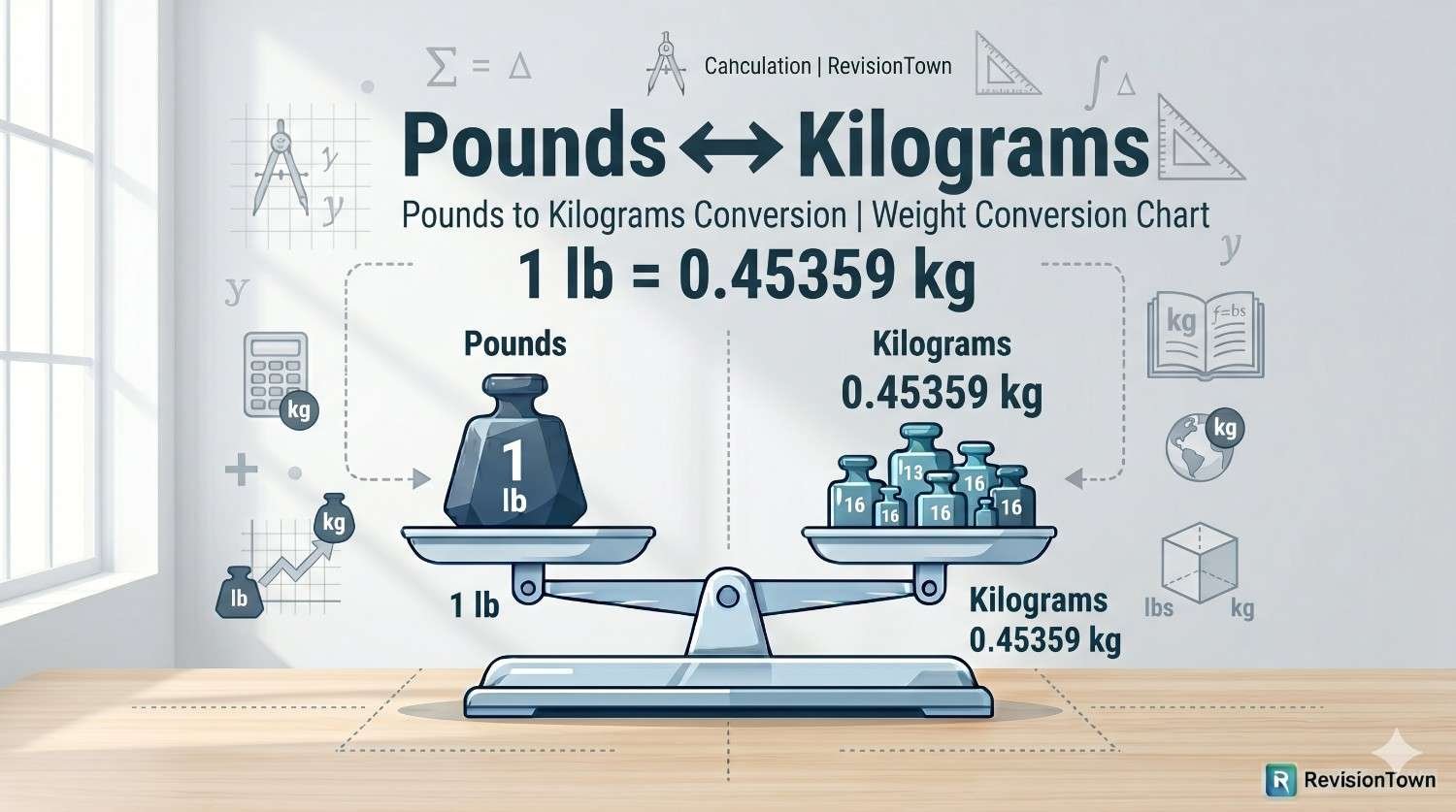
The standard conversion between pounds and kilograms is based on the internationally agreed definition: 1 pound = 0.45359237 kilograms (exact). This precise value was established by the 1959 international pound and yard agreement among English-speaking nations. The conversion formula from pounds to kilograms is: kg = lb × 0.45359237. For reverse conversion (kilograms to pounds): lb = kg ÷ 0.45359237 or equivalently lb = kg × 2.20462. For practical purposes, many applications use the rounded value 1 lb ≈ 0.4536 kg or the inverse relationship 1 kg ≈ 2.2 lb for quick calculations. The choice of precision depends on context—scientific and medical work requires full precision, while fitness tracking can use rounded values. The relationship 1 kg ≈ 2.2 lb is particularly useful for quick mental estimates.
Common Pound to Kilogram Conversions
| Pounds (lb) | Kilograms (kg) | Common Use |
|---|---|---|
| 1 lb | 0.45 kg | Basic conversion reference |
| 10 lb | 4.54 kg | Small weight increments |
| 50 lb | 22.68 kg | Luggage weight, fitness goals |
| 100 lb | 45.36 kg | Weight milestones |
| 130 lb | 58.97 kg | Average female body weight (US) |
| 150 lb | 68.04 kg | Common body weight reference |
| 180 lb | 81.65 kg | Average male body weight (US) |
| 200 lb | 90.72 kg | Fitness tracking milestone |
Practical Applications and Real-World Usage
Fitness and Health Tracking: Converting body weight between pounds and kilograms for international fitness apps, gym equipment, and health monitoring. Many fitness trackers and smart scales support both units. Medical and Healthcare: Patient weight for medication dosing, BMI calculations, clinical records, and international medical consultations. Medical professionals worldwide primarily use kilograms. International Travel: Understanding luggage weight limits when traveling internationally. Most airlines use kilograms for baggage allowances (typically 23 kg = 50.7 lb per checked bag). Sports and Athletics: Weightlifting, boxing weight classes, wrestling categories, and athletic performance tracking. Olympic weightlifting uses kilograms exclusively. Science and Laboratory: Precision measurements in physics, chemistry, biology, and engineering. Scientific work globally uses metric units (kilograms). E-commerce and Shipping: International product shipping, customs declarations, and package weight specifications for global commerce.
Historical Context and International Standardization
The relationship between pounds and kilograms was formally standardized in 1959 through the international pound and yard agreement. Before this, different English-speaking countries used slightly different pound definitions (the US used 453.59243 g while the UK used 453.59265 g), causing confusion in international trade, science, and manufacturing. The 1959 agreement among the United States, United Kingdom, Canada, Australia, New Zealand, and South Africa unified these definitions, establishing the pound as exactly 0.45359237 kilograms. This standardization was crucial for international commerce, scientific collaboration, and manufacturing consistency. The specific value was chosen to closely match the historical avoirdupois pound while providing an exact metric equivalent. Today, this conversion factor is legally defined and universally accepted worldwide, ensuring consistency across borders and measurement systems.
Tips for Accurate and Quick Conversion
Memorize Key Relationships: Remember 1 kg ≈ 2.2 lb for quick mental calculations. A 70 kg person weighs approximately 154 pounds (70 × 2.2). Choose Appropriate Precision: Use 0.45359237 for scientific work, 0.4536 for general accuracy, 0.45 for quick estimates. Understand Context: Medical and pharmaceutical applications require high precision; fitness tracking allows more flexibility. Use Digital Tools: Calculators and conversion apps ensure accuracy for important calculations in medical, travel, and professional contexts. Double-Check Units: Always verify whether you're converting to or from pounds/kilograms to avoid potentially dangerous errors in medical or engineering contexts. Round Appropriately: Match output precision to input measurement accuracy—don't show false precision. Verify Luggage Limits: When traveling internationally, always check airline-specific weight limits and whether they're stated in pounds or kilograms to avoid excess baggage fees.
Body Weight Conversion Guidelines
Body weight conversion between pounds and kilograms is one of the most common uses of this converter. For fitness tracking and general health monitoring, rounding to 0.1 kg or 1 decimal place provides sufficient accuracy. For medical contexts requiring precise medication dosing, use higher precision. Common body weight ranges: Underweight BMI typically below 110 lb (50 kg) for average height; Normal weight ranges from 110-180 lb (50-82 kg) depending on height and body composition; Overweight ranges typically 180-220 lb (82-100 kg); Obesity classifications begin above 220 lb (100 kg) for average heights. Remember that BMI calculations use kilograms, so conversions are essential when working with US body weight measurements. Many international health organizations and medical studies exclusively report in kilograms, making conversion skills vital for understanding global health data.
Why Choose RevisionTown's Pounds to Kilograms Converter?
Our advanced converter provides comprehensive, accurate conversions by: (1) Using the exact international standard conversion factor 0.45359237 kilograms per pound; (2) Offering bidirectional conversion—pounds to kilograms and kilograms to pounds; (3) Supporting bulk conversions for multiple values simultaneously; (4) Providing quick reference tables for common body weights and conversions; (5) Displaying conversion formulas with appropriate mathematical precision; (6) Including comprehensive educational content about both measurement systems; (7) Offering instant, real-time calculations without page reloads; (8) Mobile-responsive design optimized for use anywhere, anytime; (9) Completely free with no registration or payment required. Whether you're tracking fitness goals, preparing for international travel, working in healthcare, participating in sports, or conducting scientific research, RevisionTown provides the accuracy, speed, and reliability you need for confident weight conversions between Imperial and metric systems.
❓ Frequently Asked Questions - Pounds to Kilograms
One pound equals exactly 0.45359237 kilograms according to the international standard definition established in 1959. For practical purposes, 1 lb = 0.4536 kg or approximately 0.45 kg is commonly used. This conversion factor is based on the international pound and yard agreement that standardized measurements across English-speaking nations (United States, United Kingdom, Canada, Australia, New Zealand, South Africa). The exact value 0.45359237 kg should be used in scientific, medical, and precision engineering contexts, while 0.45 kg is acceptable for quick estimates and everyday calculations.
To convert pounds to kilograms, use the formula: kg = lb × 0.45359237. For example: 150 pounds = 150 × 0.45359237 = 68.0388555 kg ≈ 68.04 kg. For quick mental estimates, multiply by 0.45 or divide by 2.2. The conversion works because 1 lb is internationally defined as exactly 0.45359237 kg. This mathematical relationship allows precise conversion between Imperial and metric weight systems. Use a calculator for accurate conversions, especially when precision matters in medical applications, fitness tracking, or scientific calculations where accuracy affects results.
To convert kilograms to pounds, divide the kilogram value by 0.45359237, or multiply by 2.20462. The formula is: lb = kg ÷ 0.45359237 or lb = kg × 2.20462. For example: 75 kilograms = 75 × 2.20462 = 165.3465 lb ≈ 165.35 lb. For quick estimates, multiply by 2.2 (most common method). This reverse conversion is essential when working with metric measurements but needing Imperial units, common in American fitness tracking, medical contexts in the US, or when traveling from metric countries to the United States or UK where pounds are still commonly used for body weight.
No, 1 kilogram is not equal to exactly 2 pounds. One kilogram equals approximately 2.20462 pounds (1 kg × 2.20462 = 2.20462 lb). Many people round this to 2.2 pounds for quick mental calculations, which is accurate enough for most everyday purposes. The difference between 2.0 and 2.20462 represents about 10% error, which could be significant in medical dosing, scientific calculations, or precise fitness tracking. For quick estimates, remember: 1 kg ≈ 2.2 lb, and conversely, 1 lb ≈ 0.45 kg. This approximation is widely used and provides sufficient accuracy for most practical applications.
One kilogram is heavier than one pound. Specifically, 1 kilogram = 2.20462 pounds, making a kilogram more than twice as heavy as a pound. Alternatively, 1 pound = 0.45359237 kilograms, meaning a pound is less than half a kilogram. This difference is significant when comparing weights internationally—a 70 kg person weighs 154 pounds, not 70 pounds. Understanding this relationship prevents confusion when traveling internationally, reading product labels, following fitness programs, or interpreting medical information from different countries. Kilograms are the larger unit, so weight values expressed in kilograms will always be numerically smaller than the same weight expressed in pounds.
The difference comes from historical measurement system development. The pound is part of the Imperial/US customary system developed in England and adopted by former British colonies. The United States continues using pounds for most everyday measurements. The kilogram is part of the metric system developed in France in the late 1700s and adopted by most countries worldwide due to its decimal-based simplicity. The United Kingdom officially adopted the metric system but still commonly uses pounds for body weight. Most other countries (Canada, Australia, European nations, Asia, Africa, South America) use kilograms exclusively. Scientific work globally uses metric units (kilograms) regardless of country. International standardization efforts continue, but cultural habits and infrastructure investments make complete conversion challenging.
To convert your body weight from pounds to kilograms for international use, multiply your weight in pounds by 0.45359237, or for quick calculation, multiply by 0.45 or divide by 2.2. For example: if you weigh 165 pounds, your weight in kilograms is 165 × 0.4536 ≈ 74.8 kg (or 165 ÷ 2.2 ≈ 75 kg). This conversion is useful for: international travel (luggage weight limits), medical consultations abroad (most countries use kg), fitness apps and gym equipment (many use metric), online shopping for clothing (international size charts often use kg), and understanding global health statistics. For most practical purposes, rounding to 0.1 kg provides sufficient precision for body weight tracking.
Yes, this converter is perfect for checking airline luggage weight limits when traveling internationally. Most international airlines specify baggage limits in kilograms (typically 23 kg for checked bags, 7-10 kg for carry-on), while US domestic flights may use pounds (50 lb checked, 15-22 lb carry-on). Common conversions: 23 kg ≈ 50.7 lb (standard international checked bag), 32 kg ≈ 70.5 lb (heavy checked bag), 7 kg ≈ 15.4 lb (typical carry-on), 10 kg ≈ 22 lb (maximum carry-on for some airlines). Always check your specific airline's policy as limits vary. Using this converter before packing helps avoid excess baggage fees, which can be expensive ($50-200 per overweight bag). Weigh your luggage at home in pounds, then convert to verify compliance with kilogram limits.