
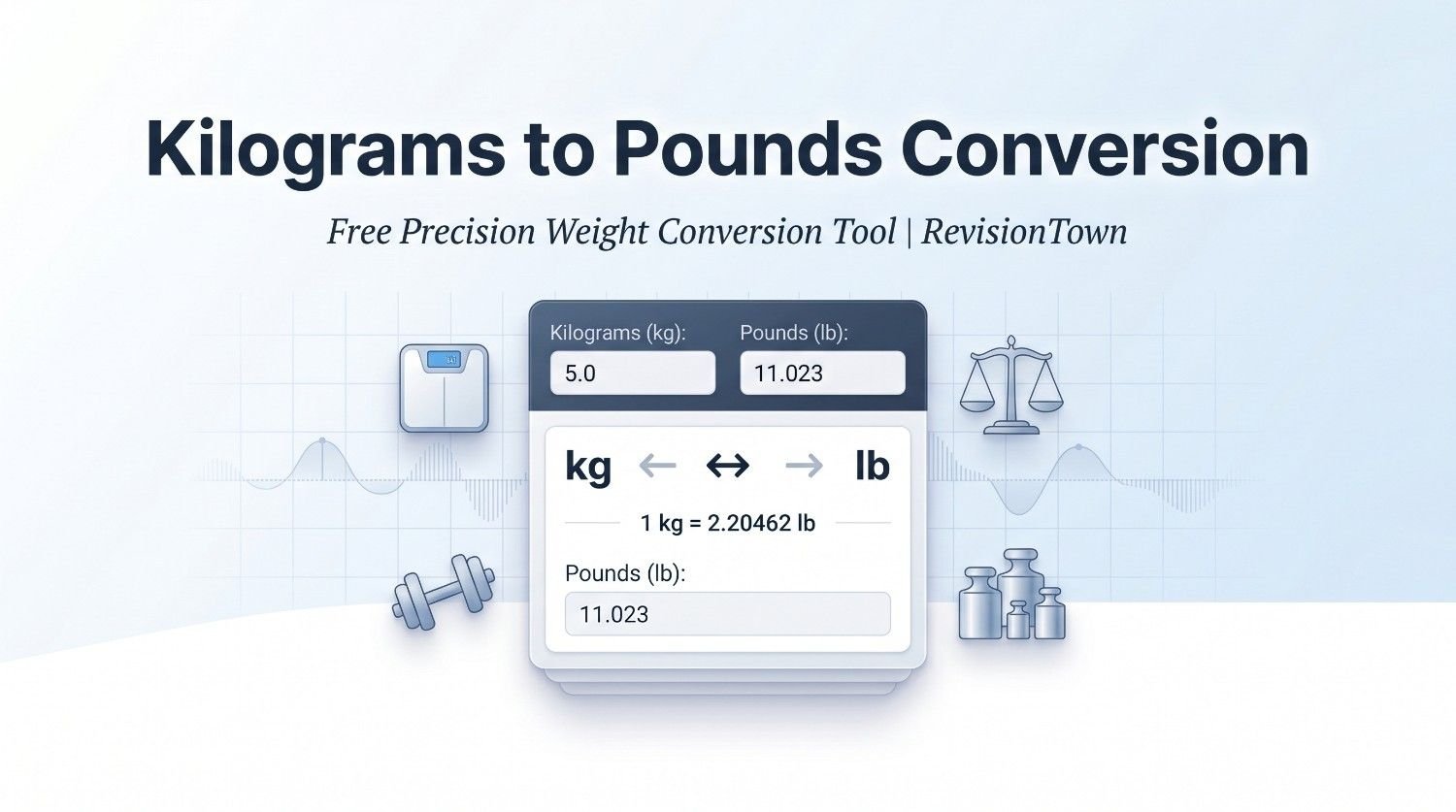
Kilograms to Pounds Converter
Convert between kilograms (kg) and pounds (lbs) instantly
Conversion Result:
1 kg = 2.20462 lbs
Quick Conversion Reference
Understanding Kilograms and Pounds
Kilograms and pounds are the primary units of mass measurement in the metric and imperial systems, respectively. The kilogram is the base unit of mass in the International System of Units (SI), used by most countries worldwide. The pound is the standard unit in the United States customary system and is still commonly used in the United States, United Kingdom, and a few other countries for everyday weight measurements.
• Kilogram (kg): The SI base unit of mass, defined by the Planck constant since 2019. Originally based on the mass of one liter of water at 4°C.
• Pound (lb or lbs): A unit of mass in the imperial system. One pound equals exactly 0.45359237 kilograms by international agreement (1959).
The conversion between kilograms and pounds is one of the most frequently needed weight conversions in everyday life. Whether you're tracking body weight, calculating luggage allowances for international flights, following recipes from different countries, or working in international trade, understanding this conversion is essential. The relationship is fixed: 1 kilogram equals approximately 2.205 pounds, making kilograms lighter than pounds.
Conversion Formula Explained
The conversion between kilograms and pounds uses a fixed conversion factor established by international agreement. This factor precisely relates the metric and imperial measurement systems.
Kilograms to Pounds Formula
For practical everyday use, this is typically rounded to:
Or for quick mental calculations:
To convert kilograms to pounds, multiply the kilogram value by 2.20462. This conversion factor means that kilograms are "heavier" units than pounds—one kilogram contains more than two pounds of mass.
Pounds to Kilograms Formula
Alternatively:
To convert pounds to kilograms, divide the pound value by 2.20462, or multiply by 0.45359237. Both methods produce the same result.
Step-by-Step Conversion Guide
How to Convert Kilograms to Pounds
- Identify the Kilogram Value: Determine the weight in kilograms you need to convert.
- Apply the Conversion Factor: Multiply the kilogram value by 2.20462 for precision, or by 2.2 for quick estimates.
- Calculate the Result: Perform the multiplication to obtain pounds.
- Round Appropriately: For everyday use, round to one or two decimal places.
- Verify Your Answer: The pound value should be more than twice the kilogram value.
Practical Example 1: Converting 70 kg to Pounds
Formula: lbs = kg × 2.20462
Calculation: 70 × 2.20462 = 154.3234
Result: 70 kg ≈ 154.32 lbs
How to Convert Pounds to Kilograms
- Identify the Pound Value: Determine the weight in pounds you need to convert.
- Apply the Conversion Factor: Divide the pound value by 2.20462, or multiply by 0.45359237.
- Calculate the Result: Perform the division or multiplication to obtain kilograms.
- Round Appropriately: Round to the desired precision (typically 1-2 decimal places).
- Verify Your Answer: The kilogram value should be less than half the pound value.
Practical Example 2: Converting 150 lbs to Kilograms
Formula: kg = lbs ÷ 2.20462
Calculation: 150 ÷ 2.20462 = 68.0389
Result: 150 lbs ≈ 68.04 kg
Comprehensive Conversion Table
Use this detailed conversion table for quick reference when converting between kilograms and pounds:
| Kilograms (kg) | Pounds (lbs) | Common Usage |
|---|---|---|
| 0.5 kg | 1.10 lbs | Small package, book |
| 1 kg | 2.20 lbs | Bag of sugar, liter of water |
| 5 kg | 11.02 lbs | Bag of flour, small pet |
| 10 kg | 22.05 lbs | Bowling ball, toddler |
| 20 kg | 44.09 lbs | Carry-on luggage limit |
| 23 kg | 50.71 lbs | Standard checked baggage |
| 50 kg | 110.23 lbs | Average adult female weight |
| 70 kg | 154.32 lbs | Average adult male weight |
| 80 kg | 176.37 lbs | Large adult, heavy luggage |
| 100 kg | 220.46 lbs | Heavy adult, motorcycle |
Real-World Applications
Converting between kilograms and pounds is one of the most practical weight conversions in everyday life. Here are common scenarios where this conversion is essential:
Health and Fitness
- Body Weight Tracking: International health standards use kilograms, while US healthcare often uses pounds. Converting between them helps track weight loss or gain consistently.
- BMI Calculations: Body Mass Index formulas may require weight in either unit depending on the calculator used.
- Fitness Goals: Gym equipment and exercise programs may use different units depending on their origin.
- Nutrition and Diet Plans: Weight-based calorie calculations and macro tracking may require unit conversions.
- Medical Documentation: Patient records may need conversion between systems for international care or specialist consultations.
Travel and Aviation
- Baggage Allowances: Airlines specify luggage limits in kilograms internationally and pounds in the US (e.g., 23 kg ≈ 50 lbs).
- Personal Weight Limits: Some small aircraft and adventure activities have weight restrictions that may be stated in either unit.
- Shipping and Freight: International shipping requires weight declarations in kilograms, while domestic US shipping often uses pounds.
- Travel Planning: Understanding weight limits helps avoid excess baggage fees.
Sports and Athletics
- Weight Classes: Boxing, wrestling, MMA, and weightlifting have weight divisions specified in either kilograms or pounds depending on the organization.
- Strength Training: Barbells and weights may be labeled in kg (Olympic standard) or lbs (US standard).
- Performance Metrics: Athletic records and personal bests may be tracked in either unit.
- Equipment Specifications: Sports equipment weight ratings may use either measurement system.
Commerce and Manufacturing
- Product Specifications: Manufacturing standards and product manuals may list weights in either unit depending on the country of origin.
- International Trade: Import/export documentation requires accurate weight conversions for customs declarations.
- E-commerce: Online retailers selling internationally must display weights in multiple units.
- Shipping Costs: Freight carriers calculate costs based on weight, requiring conversions for accurate pricing.
Daily Life
- Cooking and Recipes: International recipes may specify ingredient quantities in kilograms while US recipes use pounds.
- Baby Growth Tracking: Pediatricians in different countries track infant weight in different units.
- Pet Care: Veterinary dosing and feeding recommendations may use either unit.
- Home Improvement: Material specifications (concrete, soil, mulch) may be sold by weight in either unit.
Understanding the Pound System
The pound has several variations and related units that are important to understand:
Avoirdupois Pound (Common Pound)
This is the standard pound used in everyday measurements:
- 1 avoirdupois pound = 16 ounces
- 1 avoirdupois pound = 0.45359237 kilograms (exact definition)
- Used for body weight, food, commerce, and general purposes
- Abbreviated as "lb" or "lbs" (from the Latin "libra")
Stone (UK Measurement)
The stone is commonly used in the UK and Ireland for body weight:
- 1 stone = 14 pounds
- 1 stone = 6.35029 kilograms
- Example: A person weighing 70 kg = 11 stone or 154 lbs
Troy Pound (Precious Metals)
Used exclusively for precious metals:
- 1 troy pound = 12 troy ounces
- 1 troy pound = 0.3732417216 kilograms
- Lighter than the avoirdupois pound
- Rarely used today (troy ounces are more common)
Body Weight Conversion Guide
Body weight conversion is one of the most common uses for kg to lbs calculations. Here's a detailed reference for typical body weights:
| Kilograms (kg) | Pounds (lbs) | Context |
|---|---|---|
| 3-5 kg | 6.6-11 lbs | Newborn baby |
| 10-15 kg | 22-33 lbs | Toddler (1-2 years) |
| 20-25 kg | 44-55 lbs | Child (5-7 years) |
| 40-50 kg | 88-110 lbs | Adolescent/Small adult |
| 55-70 kg | 121-154 lbs | Average adult female |
| 70-85 kg | 154-187 lbs | Average adult male |
| 90-100 kg | 198-220 lbs | Large adult/Athlete |
| 100+ kg | 220+ lbs | Very large adult/Powerlifter |
Common Conversion Mistakes to Avoid
- Using Wrong Conversion Factor: Don't use 2.0 or 2.5—the correct factor is 2.20462. Using 2.0 gives a 10% error.
- Rounding Too Early: Multiply first, then round the final result to avoid cumulative rounding errors.
- Confusing Direction: Remember: kg to lbs = multiply by 2.2; lbs to kg = divide by 2.2 (or multiply by 0.45).
- Mixing Stone and Pounds: In UK measurements, don't confuse stone (14 lbs) with individual pounds.
- Decimal Point Errors: Be careful with calculator entry—2.20462, not 220462 or 0.220462.
- Unit Label Omission: Always specify kg or lbs to avoid confusion about which unit you're using.
- Troy vs Avoirdupois: Don't use troy pounds for general weight (they're 25% lighter than regular pounds).
- Assuming Exact Doubles: 1 kg is NOT equal to 2 lbs—it's 2.2 lbs. This 10% difference matters.
Tips for Quick Mental Conversions
- The "Double Plus 10%" Rule: To estimate kg to lbs, double the kg value and add 10%. Example: 50 kg → 100 + 10 = 110 lbs (actual: 110.23)
- The "Halve Minus 10%" Rule: To estimate lbs to kg, halve the lbs value and subtract 10%. Example: 100 lbs → 50 - 5 = 45 kg (actual: 45.36)
- Memorize Key Values: Know that 10 kg ≈ 22 lbs, 50 kg ≈ 110 lbs, 100 kg ≈ 220 lbs
- Use Benchmark Weights: Remember your own body weight in both units as a reference point
- Round Strategically: For rough estimates, using 2.2 as the factor is usually close enough
- Check Your Work: Pounds should always be a bigger number than kilograms for the same weight
- Practice Common Conversions: Airlines typically use 23 kg (50.7 lbs) and 7 kg (15.4 lbs) as baggage limits
- Use Technology: For precision (medical, sports), always use a calculator like this one
International Weight Standards
Understanding global weight measurement practices helps navigate international contexts:
| Region/Country | Primary Unit | Notes |
|---|---|---|
| United States | Pounds (lbs) | Imperial system standard; metric used in science/medicine |
| United Kingdom | Mixed (kg and stone/lbs) | Officially metric, but stone/pounds used for body weight |
| Canada | Kilograms (kg) | Officially metric; pounds still understood |
| Europe | Kilograms (kg) | Exclusively metric across EU |
| Australia/NZ | Kilograms (kg) | Fully metric since 1970s |
| Asia | Kilograms (kg) | Most countries use metric exclusively |
| Latin America | Kilograms (kg) | Metric system standard |
| Aviation (Global) | Kilograms (kg) | International standard for aircraft weight |
Frequently Asked Questions
How many pounds are in one kilogram?
There are approximately 2.20462 pounds in one kilogram. More precisely, 1 kilogram equals 2.2046226218 pounds according to the international definition. For most everyday purposes, using 2.2 pounds per kilogram provides sufficient accuracy. This means that kilograms are "heavier" units—one kilogram contains more than two pounds of mass.
How do I convert 70 kg to pounds?
To convert 70 kg to pounds, multiply 70 by 2.20462. The calculation is: 70 × 2.20462 = 154.3234 pounds. Rounded to two decimal places, 70 kg equals approximately 154.32 lbs. This is a common body weight conversion, as 70 kg represents the average weight for many adults.
Is 1 kg equal to 2 lbs?
No, 1 kilogram does not equal exactly 2 pounds—it equals approximately 2.2 pounds. The difference of 0.2 pounds (about 10%) becomes significant with larger weights. For example, 100 kg equals 220 lbs, not 200 lbs. Using 2.0 as the conversion factor creates a 10% error, which matters for accurate measurements.
Why is the conversion 2.2 instead of a round number?
The conversion factor is 2.20462 because kilograms and pounds were developed independently in different measurement systems with different historical origins. The kilogram is based on the metric system (mass of water), while the pound comes from ancient Roman and medieval English systems. The 1959 International Yard and Pound Agreement established the exact relationship (1 lb = 0.45359237 kg) to standardize international trade.
How do I convert pounds to kilograms?
To convert pounds to kilograms, divide the pound value by 2.20462. For example, 150 pounds ÷ 2.20462 = 68.04 kilograms. Alternatively, you can multiply pounds by 0.45359237 to get kilograms. Both methods produce the same result. The kilogram value will always be less than half the pound value.
What is the difference between lbs and pounds?
There is no difference—"lbs" and "pounds" refer to the same unit of measurement. "Lbs" is the abbreviation for pounds, derived from the ancient Roman unit "libra pondo" (pound weight). The "lb" abbreviation comes from "libra." Both singular (lb) and plural (lbs) forms are commonly used, though "lb" is technically correct for both.
How much is 23 kg in pounds for luggage?
23 kg equals approximately 50.71 pounds. This is a crucial conversion for air travel, as 23 kg (50 lbs) is the standard checked baggage weight limit for most international airlines. Knowing this conversion helps avoid excess baggage fees. Similarly, 7 kg equals approximately 15.4 pounds, which is a common carry-on weight limit.
Which is heavier: 1 kg or 1 lb?
1 kilogram is heavier than 1 pound. Specifically, 1 kg equals approximately 2.2 pounds, meaning one kilogram weighs more than twice as much as one pound. Conversely, 1 pound equals only about 0.45 kilograms. This means if you weigh 70 kg, you weigh 154 lbs—the number is larger in pounds because pounds are smaller units.
How accurate do I need to be for body weight conversions?
For personal body weight tracking, rounding to one decimal place (using 2.2 as the factor) is typically sufficient. For medical purposes, use 2.20462 and round to two decimal places. For professional athletics with weight classes, use the full precision (2.2046226218) to ensure athletes meet exact category limits. Match your conversion precision to your measurement accuracy.
Historical Background
The kilogram and pound have rich histories that explain their modern relationship and why their conversion isn't a simple whole number.
Origin of the Pound
The pound originated from the Roman "libra pondo," meaning "a pound by weight." The ancient Roman libra was divided into 12 unciae (ounces). In medieval England, various pounds existed for different commodities: tower pound, merchant's pound, and troy pound. The avoirdupois pound, established in the 13th century for weighing wool and general goods, eventually became the standard. The word "avoirdupois" comes from Old French meaning "goods of weight."
Origin of the Kilogram
The kilogram was created in 1795 during the French Revolution as part of the new metric system designed to replace the chaotic array of regional measurements. It was originally defined as the mass of one liter (1000 cubic centimeters) of pure water at 4°C, the temperature at which water has maximum density. A physical prototype—a platinum-iridium cylinder—served as the international standard from 1889 until 2019.
The 1959 Agreement
The International Yard and Pound Agreement of 1959 was a watershed moment. The United States, United Kingdom, Canada, Australia, New Zealand, and South Africa agreed to define their units in terms of metric units. The avoirdupois pound was defined as exactly 0.45359237 kilograms. This agreement ensured that "one pound" meant the same thing worldwide and could be precisely converted to metric units.
Modern Definition (2019)
On May 20, 2019, the kilogram was redefined based on the Planck constant, a fundamental constant of nature. This change freed the kilogram from dependence on a physical object and anchored it to unchanging physics. Since the pound is defined in terms of the kilogram (1 lb = 0.45359237 kg exactly), this redefinition improved the stability and precision of both units.