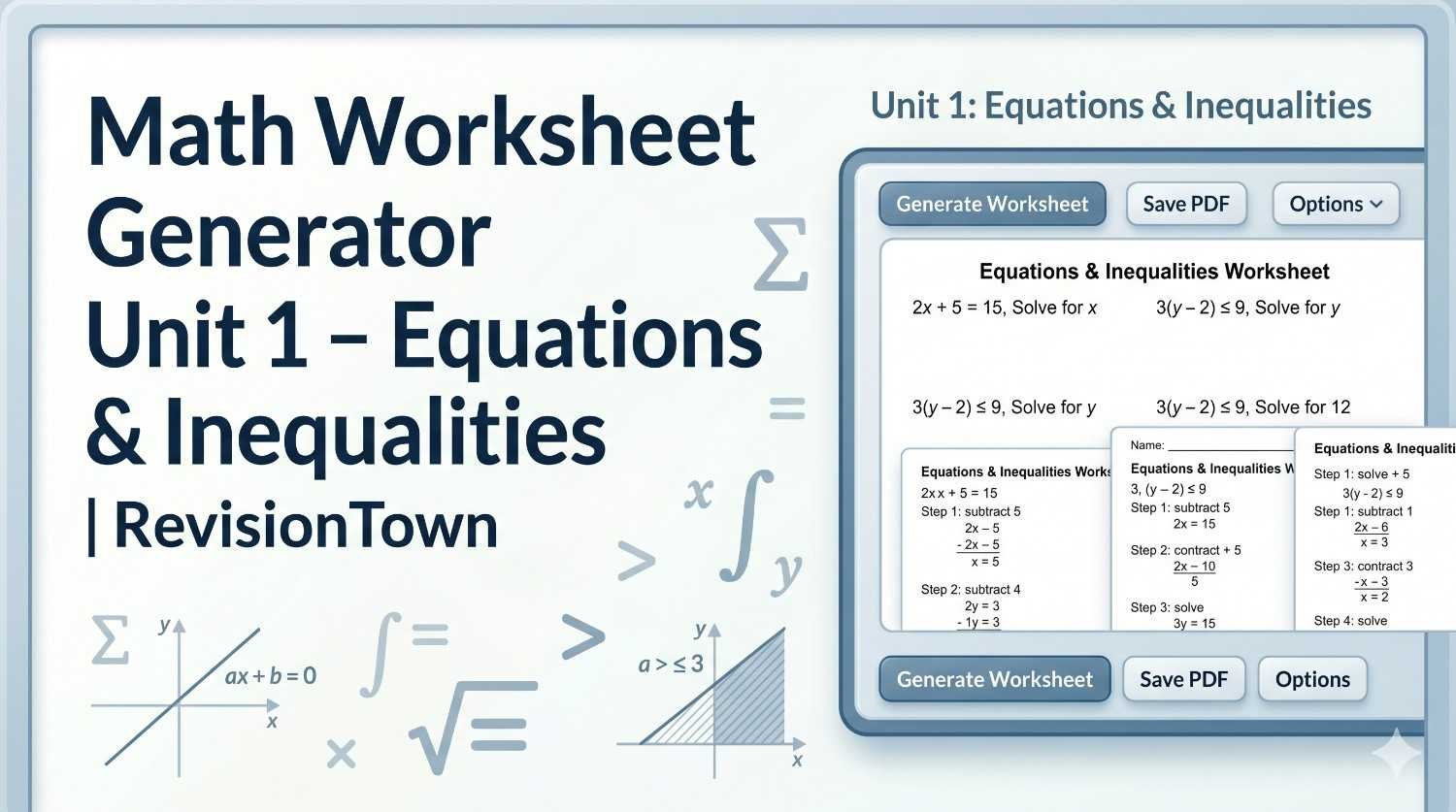
Create printable K-12 math worksheets by grade level, topic, difficulty, and question count, with an optional answer key for quick checking.
Quick setup: choose a grade, select a topic, set the difficulty, generate a fresh worksheet, then print, save, or share the practice set.
A sample worksheet is ready below. Change the options to generate a new practice set.
About This Worksheet Generator
Best use: create quick arithmetic, fractions, decimals, geometry, algebra, statistics, trigonometry, precalculus, and calculus practice without manually writing every problem.
What changed from the basic version: the generator now supports difficulty settings, variable question counts, cleaner printable formatting, stronger answer keys, teacher-friendly metadata, responsive styling, and richer on-page guidance.
The worksheet is generated in the browser. RevisionTown does not need a login for this tool, and typed names are only used to label the printable worksheet on the current page.
Grade-Level Math Worksheet Guide
A useful worksheet should match the learner's current skill band. Very easy sheets create speed but little growth; overly difficult sheets create frustration and guessing. The generator organizes topics by grade level so a kindergarten sheet emphasizes counting and early addition, while high-school levels include algebra, functions, statistics, trigonometry, precalculus, and introductory calculus.
For classroom use, start with review difficulty when introducing a topic, move to standard difficulty for independent practice, and reserve challenge difficulty for extension work, tutoring, math clubs, or test preparation. For home practice, short sets of 10 to 15 questions are usually enough for daily fluency, while 20 to 25 questions work better for weekly review.
| Grade Band | Main Skill Focus | Good Worksheet Topics | Practice Goal |
|---|---|---|---|
| K-2 | Number sense and early operations | Counting, addition, subtraction, basic multiplication | Build confidence with numbers, facts, and place value. |
| 3-5 | Fluency with operations and fractions | Multiplication, division, fractions, decimals, geometry | Move from single-step facts to multi-step reasoning. |
| 6-8 | Ratios, percents, integers, and pre-algebra | Percents, ratios, integers, algebra, linear equations | Prepare for equation solving and coordinate-plane work. |
| 9-10 | Algebra, geometry, and functions | Advanced algebra, systems, geometry, trigonometry | Strengthen symbolic manipulation and problem solving. |
| 11-12 | Advanced functions and analysis | Precalculus, statistics, calculus | Practice college-prep math with clean worked answers. |
What Each Worksheet Topic Covers
Each generated set uses small variations so students cannot simply memorize a pattern. Arithmetic topics emphasize accuracy and fluency, while upper-level topics include equations, functions, data sets, derivatives, and right-triangle values. The answer key is intentionally concise so it can be checked quickly during class, tutoring, or self-study.
| Topic | Skills Practiced | Best For | Answer Type |
|---|---|---|---|
| Counting | Skip counting, number order, missing numbers | Kindergarten and early grade 1 | Number sequence or missing value |
| Addition and Subtraction | Facts, regrouping, multi-digit arithmetic | Grades 1-6 review and fluency | Exact whole number |
| Multiplication and Division | Times tables, factors, whole-number quotients | Grades 2-6 and intervention review | Exact product or quotient |
| Fractions and Decimals | Operations, simplifying, place-value arithmetic | Grades 4-8 and middle-school review | Simplified fraction or rounded decimal |
| Percents and Ratios | Percent of a number, equivalent ratios, simplification | Grades 6-8, finance, and proportion work | Exact value or simplified ratio |
| Algebra and Linear Equations | Solving for x, slope, evaluating functions | Grades 7-10 and algebra readiness | Variable value or coordinate output |
| Geometry and Trigonometry | Area, perimeter, circumference, right-triangle trig | Grades 5-10 and exam preparation | Exact or rounded measurement |
| Statistics, Precalculus, Calculus | Mean, median, range, exponents, logs, derivatives | Grades 9-12 and advanced review | Numeric answer or expression |
How to Build a Better Practice Routine
For skill building, use one worksheet as a short diagnostic and a second worksheet as targeted follow-up. If a student misses several questions from the same topic, the best next step is not more random practice; it is a smaller set that isolates the exact error. For example, subtraction mistakes may come from regrouping, place-value alignment, or sign errors. Algebra mistakes may come from distributing, combining like terms, or moving terms across an equals sign.
A practical routine is: generate 10 review questions, check the answer key, mark the error type, reteach the weakest step, then generate 10 standard questions. This creates a visible feedback loop. Teachers can use challenge sets for early finishers, while parents can use review sets to keep practice short and consistent.
A worksheet is most useful when the student can attempt it independently, receive feedback quickly, and revisit the same skill later with slightly different numbers.
Worksheet Quality Checklist
Before printing or assigning a generated worksheet, scan it for fit. A high-quality math worksheet should be clear, focused, and easy to check. It should also leave room for work, especially in multi-step problems where the final answer alone does not show whether the method is sound.
- One main skill per worksheet: mixed review is useful later, but new learning works best when the sheet has a narrow focus.
- Enough spacing: students should have space to calculate, especially for fractions, long division, geometry, and algebra.
- Answer key included when needed: quick feedback helps learners correct mistakes before they become habits.
- Appropriate number size: younger learners need smaller numbers; older learners can handle larger values and multi-step equations.
- Difficulty matched to purpose: review builds fluency, standard builds independence, and challenge extends understanding.
- Errors reviewed by type: track whether mistakes are arithmetic, notation, setup, reading, or concept errors.
Worked Examples
The generator creates new numbers each time, but the reasoning behind each topic stays consistent. These examples show the expected level of answer detail for several common worksheet types.
Step: add ones, tens, then hundreds while regrouping as needed.
Answer: 725.
Step: common denominator 12 gives 3/12 + 8/12.
Answer: 11/12.
Step: add 7 to both sides, then divide by 5.
Answer: x = 5.
Using Worksheets for Assessment and Review
A generated worksheet can be used as classwork, homework, tutoring practice, station work, warm-up review, exit ticket practice, or test preparation. The best format depends on the goal. For speed fluency, use a short timed set. For understanding, remove the timer and ask students to show work. For intervention, create repeated review sheets at the same difficulty level until accuracy improves.
When using worksheets as assessment, avoid judging a student from one generated set. Instead, compare performance across several attempts. A student who improves from 8 out of 15 to 13 out of 15 after targeted feedback has shown learning even if one topic still needs work. Keeping the answer key available for teachers and parents makes this kind of progress check easier.
Related RevisionTown Math Resources
Use these RevisionTown resources when a generated worksheet points to a topic that needs deeper study or more practice:
Source Notes and Calculation Limits
Source note: The generated questions are educational practice items based on common K-12 math skill progressions. The worksheet generator is intended for study, tutoring, homework, and classroom review. It is not a formal placement test, exam board mark scheme, or substitute for teacher judgment.
The current worksheet appears only in the browser session. If you need a permanent record, print it, download a PDF, or copy the shared text. Because the numbers are generated dynamically, pressing Generate Worksheet again will create a new version.
Frequently Asked Questions About Math Worksheets
Final Notes
A strong math worksheet generator should produce more than a random list of sums. It should match grade level, support different difficulty levels, give clear printable formatting, and provide an answer key that helps teachers, parents, and students check work quickly. This optimized RevisionTown page puts the generator first, then supports it with skill guidance, grade-level tables, examples, FAQs, internal links, and structured data for better search visibility.