
Conical Frustum Volume Calculator
Calculate the volume of a truncated cone (frustum) using top radius, bottom radius, and height
Calculation Results:
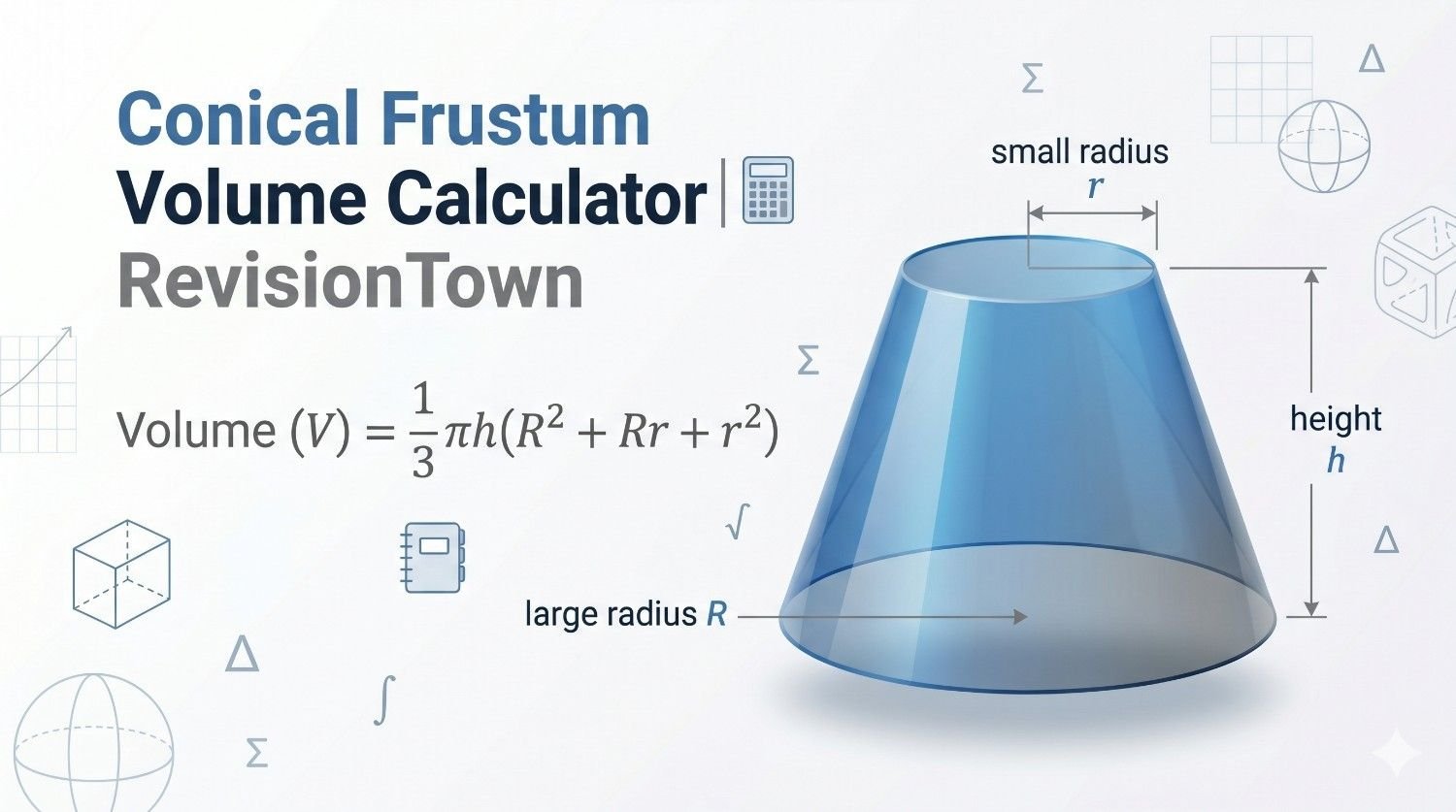
V = (πh/3) × (R² + Rr + r²)
What is a Conical Frustum?
A conical frustum, also known as a truncated cone, is a three-dimensional geometric shape created when a cone is cut by a plane parallel to its base, removing the upper portion including the apex. The resulting shape retains the circular base of the original cone and gains a second, smaller circular top. This creates a solid with two parallel circular faces of different radii connected by a curved lateral surface.
Conical frustums are ubiquitous in everyday life. Common examples include buckets, drinking glasses, lampshades, flower pots, and even some architectural elements. The shape combines structural stability with functional design, making it ideal for containers and vessels where a wider base provides stability while a narrower top facilitates pouring or access.
Conical Frustum Volume Formula
The volume of a conical frustum represents the amount of three-dimensional space enclosed within its structure. Unlike a simple cone, the frustum volume formula accounts for both circular bases and the height between them. The standard formula is derived from the difference between two cones of different sizes.
Formula Components:
- V = Volume of the frustum (cubic units)
- π = Pi (approximately 3.14159265359)
- h = Perpendicular height of the frustum (distance between the two circular bases)
- R = Radius of the larger bottom base
- r = Radius of the smaller top base
Alternative Volume Formula
Another way to express the frustum volume uses the concept of two cones:
This formula represents the volume as the difference between the volumes of the complete larger cone and the removed smaller cone. Both formulas yield identical results and are mathematically equivalent.
How to Calculate Conical Frustum Volume
Calculating the volume of a conical frustum requires careful measurement and systematic application of the formula. Follow these detailed steps:
- Measure the Top Radius (r): Determine the radius of the smaller circular face at the top of the frustum. Measure from the center to the edge.
- Measure the Bottom Radius (R): Find the radius of the larger circular face at the base. This should be greater than the top radius (R > r).
- Measure the Height (h): Calculate the perpendicular distance between the center of the top circle and the center of the bottom circle. This must be measured vertically, not along the slanted surface.
- Ensure Consistent Units: Verify that all three measurements use the same unit (cm, m, in, etc.).
- Calculate R²: Square the bottom radius (R × R).
- Calculate r²: Square the top radius (r × r).
- Calculate Rr: Multiply the two radii together (R × r).
- Sum the Terms: Add R² + Rr + r².
- Apply the Formula: Multiply the sum by πh/3 to get the volume.
Worked Example
Let's calculate the volume of a frustum with: Top radius (r) = 3 cm, Bottom radius (R) = 7 cm, Height (h) = 10 cm
Step 1: Calculate R² = 7² = 49 cm²
Step 2: Calculate r² = 3² = 9 cm²
Step 3: Calculate Rr = 7 × 3 = 21 cm²
Step 4: Sum = R² + Rr + r² = 49 + 21 + 9 = 79 cm²
Step 5: V = (π × 10 / 3) × 79
Step 6: V = (31.4159 / 3) × 79
Step 7: V = 10.472 × 79
Result: V ≈ 827.31 cm³
Slant Height of Conical Frustum
The slant height of a conical frustum is the distance measured along the curved lateral surface from a point on the edge of the top circle to the corresponding point on the edge of the bottom circle directly below it. Unlike the perpendicular height, the slant height follows the slope of the frustum's side.
Slant Height Formula
The slant height can be calculated using the Pythagorean theorem, as it forms the hypotenuse of a right triangle:
Where:
- l = Slant height of the frustum
- h = Perpendicular height between the bases
- R = Bottom radius (larger)
- r = Top radius (smaller)
- (R - r) = Difference between the radii (horizontal distance)
Surface Area of Conical Frustum
The total surface area of a conical frustum consists of three components: the area of the bottom circular base, the area of the top circular base, and the curved lateral surface area connecting them.
Lateral Surface Area
Where l is the slant height calculated using l = √[h² + (R - r)²]
Total Surface Area
This formula adds the areas of both circular bases to the lateral surface area.
Simplified Total Surface Area
Real-World Applications of Conical Frustum
Conical frustums appear extensively in both everyday objects and specialized industrial applications. Understanding frustum volume calculations has practical importance across numerous fields:
Household and Consumer Products
- Buckets and Pails: Most buckets are frustum-shaped, providing stability with a wide base while allowing easy access through the narrower top
- Drinking Glasses and Tumblers: Many glasses taper from bottom to top in a frustum shape for ergonomic handling
- Lampshades: Conical lampshades direct light downward while maintaining aesthetic proportions
- Flower Pots: Plant containers often use frustum geometry for drainage and root space optimization
- Funnels: Kitchen and laboratory funnels use truncated cone shapes to direct flow
Industrial and Engineering Applications
- Storage Silos and Hoppers: Agricultural and industrial storage vessels use frustum designs for gravity-fed material flow
- Pipe Reducers: Plumbing and HVAC systems use frustum-shaped connectors to transition between different pipe diameters
- Cooling Towers: Many industrial cooling towers feature hyperboloid or frustum shapes for optimal airflow
- Concrete Forms: Building foundations and pillars sometimes require frustum-shaped concrete pours
- Pressure Vessels: Chemical processing equipment may incorporate frustum sections in tank design
Architecture and Construction
- Column Capitals and Bases: Architectural columns often feature frustum-shaped transitional elements
- Decorative Elements: Frustum shapes appear in cornices, pilasters, and ornamental features
- Water Tanks: Elevated water storage tanks may use frustum geometry for structural efficiency
- Stadium Seating: Amphitheater designs sometimes incorporate frustum-based calculations
Food and Beverage Industry
- Food Packaging: Containers for dairy products, desserts, and snacks often use frustum shapes
- Baking Molds: Cake pans and specialty baking forms frequently feature frustum geometry
- Beverage Cups: Coffee cups, paper cups, and disposable containers commonly have frustum profiles
Mathematical Derivation of Frustum Volume
Understanding how the frustum volume formula is derived provides deeper insight into its geometric principles. The formula emerges from considering the frustum as the difference between two cones.
Derivation Method
Consider a large cone with base radius R and total height (H + h). When we remove a smaller cone with base radius r and height H from the top, we're left with a frustum of height h.
By similar triangles: H/r = (H + h)/R
Solving for H: H = hr/(R - r)
Volume of large cone: V₁ = (π/3)R²(H + h)
Volume of small cone removed: V₂ = (π/3)r²H
Volume of frustum: V = V₁ - V₂
Substituting and simplifying through algebraic manipulation yields:
Difference Between Cone, Frustum, and Cylinder
| Property | Cone | Frustum | Cylinder |
|---|---|---|---|
| Shape | Tapers to a point (apex) | Truncated, no apex | Uniform throughout |
| Bases | One circular base | Two parallel circular bases | Two identical circular bases |
| Volume Formula | V = (1/3)πr²h | V = (πh/3)(R² + Rr + r²) | V = πr²h |
| Base Radii | One radius (r) | Two different radii (R, r) | Two identical radii (r) |
| Surface | One curved surface + base | One curved surface + two bases | One curved surface + two bases |
| Volume Relationship | 1/3 of cylinder (same base & height) | Between cone and cylinder | 3 times cone (same base & height) |
Special Cases of Conical Frustum
When Top Radius Equals Zero (r = 0)
If the top radius becomes zero, the frustum degenerates into a complete cone. The formula simplifies to:
This is exactly the cone volume formula, confirming our frustum formula's validity.
When Both Radii Are Equal (r = R)
If both the top and bottom radii are identical, the frustum becomes a cylinder:
This matches the cylinder volume formula, again validating our general formula.
Short Frustum (h approaches 0)
As height approaches zero, the frustum becomes increasingly flat, like a disk or washer, and volume approaches zero proportionally to the height.
Common Mistakes to Avoid
- Confusing Radius and Diameter: Always use radius values in the formula, not diameter. If given diameters, divide by 2 first.
- Swapping R and r: R should always be the larger bottom radius, while r is the smaller top radius. Swapping them doesn't affect volume calculation due to the formula's symmetry, but it matters for slant height.
- Using Slant Height Instead of Perpendicular Height: The volume formula requires perpendicular height (h), not slant height (l).
- Inconsistent Units: All measurements must use the same unit. Mixing centimeters and meters will produce incorrect results.
- Forgetting the π/3 Factor: Don't forget to multiply by π/3 (or divide by 3 after multiplying by π).
- Calculation Order Errors: Follow the order of operations carefully: calculate squares and products first, then sum, then multiply by πh/3.
- Rounding Too Early: Use sufficient decimal places throughout calculations. Only round the final answer.
- Negative Values: Radii and height must be positive. Negative inputs indicate measurement errors.
Frequently Asked Questions
What is the difference between a cone and a frustum?
A cone is a complete three-dimensional shape that tapers from a circular base to a single point (apex). A frustum is what remains when you cut off the top of a cone with a plane parallel to the base, resulting in a shape with two circular bases of different sizes instead of a pointed top. Essentially, a frustum is a truncated cone.
How do you find the height of a frustum if you know the volume?
To find height when volume and both radii are known, rearrange the formula: h = 3V / [π(R² + Rr + r²)]. First calculate the sum (R² + Rr + r²), multiply by π, then divide 3V by this result. This gives you the perpendicular height of the frustum.
What happens if the top radius is larger than the bottom radius?
Mathematically, the volume formula still works due to its symmetry - you'll get the same volume regardless of which radius you designate as R or r. However, conventionally R represents the larger radius (bottom) and r the smaller (top). If your frustum has a wider top than bottom (inverted), simply swap the values to maintain the convention, though it doesn't affect volume calculation.
Can a frustum have a negative volume?
No, a frustum cannot have negative volume. Volume is always a positive quantity representing physical space. All three measurements (both radii and height) must be positive real numbers. If your calculation yields a negative result, check your inputs and ensure you're using absolute positive values for all dimensions.
How is frustum volume used in real life?
Frustum volume calculations are essential in many practical applications: manufacturers determine the capacity of buckets, containers, and cups; engineers calculate material volumes for silos, hoppers, and storage tanks; construction workers estimate concrete needed for frustum-shaped foundations; and food packaging designers optimize container volumes for products. Any tapered cylindrical container likely requires frustum calculations.
What is the relationship between slant height and perpendicular height?
The slant height (l) is always greater than or equal to the perpendicular height (h). They're related by the Pythagorean theorem: l² = h² + (R - r)². The slant height forms the hypotenuse of a right triangle where the height is one leg and the difference between radii is the other leg. Only use perpendicular height in volume calculations, not slant height.
How do you measure a frustum's dimensions accurately?
To measure a frustum accurately: (1) Place it on a flat surface with the larger base down. (2) Measure the diameter of the top circle and divide by 2 for radius r. (3) Measure the bottom circle diameter and divide by 2 for radius R. (4) Use a ruler or measuring tape vertically to find the perpendicular height h between the bases, ensuring it's truly vertical, not along the slanted side. Use precise measuring tools and take multiple measurements for accuracy.
What units should I use for frustum volume calculations?
You can use any unit of length for the radii and height (meters, centimeters, inches, feet, etc.), but all three measurements must use the same unit. The resulting volume will be in the corresponding cubic unit. For example, if all dimensions are in centimeters, the volume will be in cubic centimeters (cm³). Always verify unit consistency before calculating.
Is there a formula for frustum of a pyramid?
Yes, pyramidal frustums have a similar but different formula. For a frustum of a pyramid with square bases of sides a₁ and a₂ and height h, the volume is V = (h/3)(a₁² + a₁a₂ + a₂²). For pyramids with other polygonal bases, replace the squared terms with the respective base areas. The general frustum principle applies across different base shapes.
Tips for Accurate Frustum Calculations
- Double-Check Measurements: Small errors in radius or height measurements can significantly affect volume results due to squaring and multiplication
- Use Digital Tools: Online calculators like this one eliminate manual calculation errors and provide instant, accurate results
- Verify Which Radius is Larger: Confirm which circular base is larger before assigning R and r values
- Measure Perpendicular Height: Ensure height measurement is truly vertical, not along the slanted surface
- Use Sufficient Decimal Precision: Use at least 5-6 decimal places for π in manual calculations
- Consider Practical Tolerances: In real-world applications, account for manufacturing tolerances and material thickness
- Validate Results: Check if calculated volume makes physical sense given the frustum's dimensions
- Convert Units Carefully: When converting volume units, remember to cube the conversion factor
- Calculate Slant Height Separately: Don't confuse slant height with perpendicular height - calculate each distinctly
- Use Consistent Notation: Maintain clear labeling of which measurement is which throughout your calculations
Advanced Applications and Extensions
Oblique Frustums
While our calculator focuses on right frustums (where the axis is perpendicular to the bases), oblique frustums exist where the axis is tilted. The volume formula remains the same, but surface area calculations become more complex, requiring integration techniques.
Frustums in Calculus
Frustum volume can be derived using integral calculus by revolving a linear function around an axis. This method provides rigorous mathematical proof of the formula and extends to more complex rotational solids.
Frustums in Computer Graphics
In 3D computer graphics and game development, viewing frustums define the visible portion of a 3D scene. The frustum's geometry determines which objects appear on screen, making frustum calculations essential for rendering optimization and culling algorithms.
Centroid and Center of Mass
For engineering applications, finding the centroid (center of mass) of a frustum is important. The centroid height from the base is given by: h_c = h(R² + 2Rr + 3r²) / (4(R² + Rr + r²)). This is crucial for stability analysis in containers and structures.