
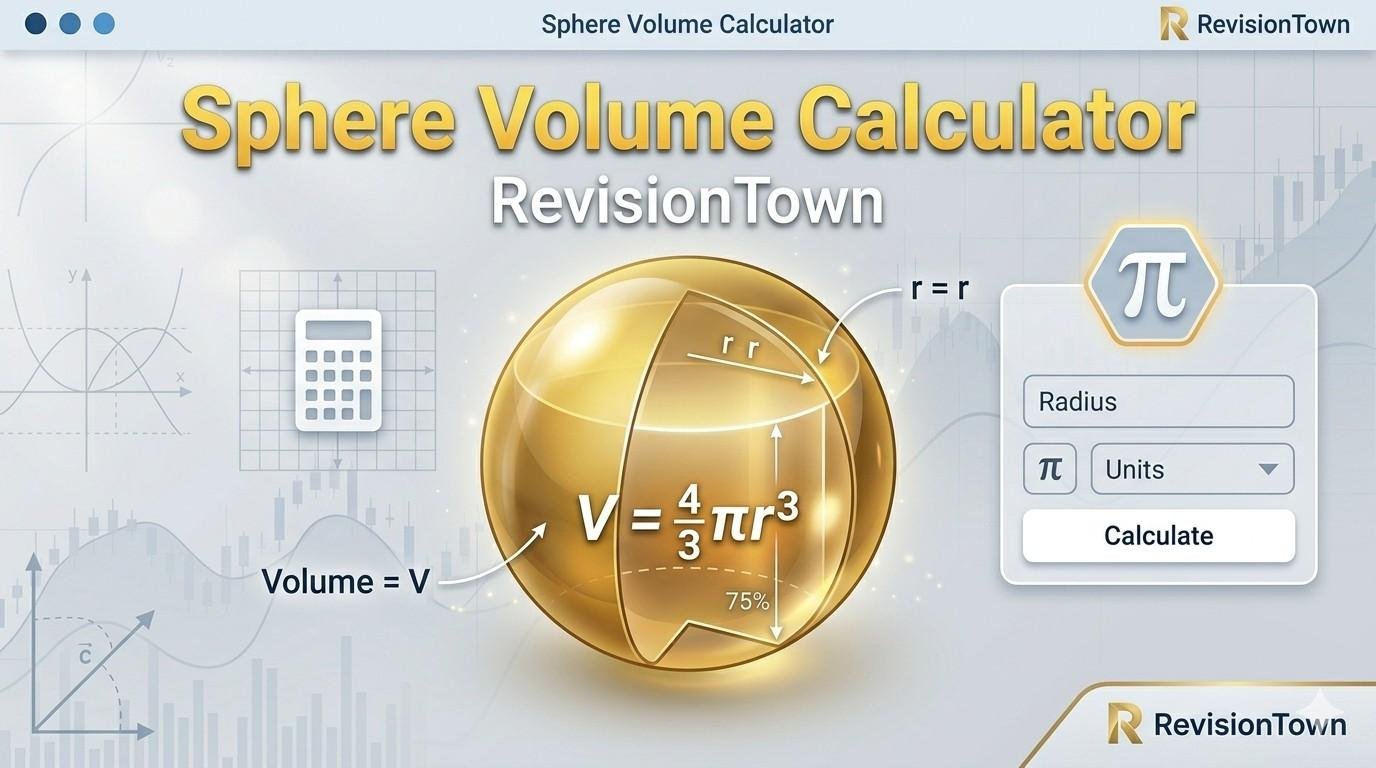
🔵 Sphere Volume Calculator
📚 Understanding Sphere Volume and Geometry
What is a Sphere and Its Definition?
A sphere is a perfectly round three-dimensional object where every point on the surface is equidistant from a central point called the center. It is the three-dimensional equivalent of a circle. A sphere has no edges, vertices, or flat surfaces—it is completely smooth and symmetrical in all directions. The distance from the center to any point on the surface is the radius (r). The distance across through the center is the diameter (d = 2r). Spheres appear throughout nature in planetary bodies, water droplets, atoms, and are fundamental to mathematics, physics, engineering, and astronomy.
Sphere Volume Formula and Calculations
| Property | Formula | Description |
|---|---|---|
| Volume | V = (4/3)πr³ | Volume using radius |
| Volume (Diameter) | V = (1/6)πd³ | Volume using diameter |
| Surface Area | SA = 4πr² | Total outer surface area |
| Radius from Volume | r = ∛(3V/4π) | Inverse volume calculation |
| Circumference | C = 2πr | Great circle circumference |
| Diameter | d = 2r | Distance across through center |
| Volume Coefficient | V/d³ = π/6 ≈ 0.5236 | Volume ratio to diameter cubed |
Understanding Cubic Relationships in Sphere Volume
The volume of a sphere exhibits a cubic relationship with its radius, meaning volume grows dramatically as radius increases. Doubling the radius increases volume by a factor of 8 (2³ = 8). Tripling the radius increases volume by a factor of 27 (3³ = 27). The formula V = (4/3)πr³ shows that even small radius increases produce substantial volume changes. For example, spheres with radii 1 cm, 2 cm, and 3 cm have volumes approximately 4.19 cm³, 33.51 cm³, and 113.10 cm³ respectively—demonstrating rapid volume growth. This cubic relationship is fundamental to understanding sphere geometry and is essential for engineering calculations, material volume estimations, and spatial analysis.
Practical Applications of Sphere Volume
Storage and Tank Design: Determining capacity of spherical storage tanks and vessels. Manufacturing: Ball bearing and sphere production with volume requirements. Astronomy: Calculating volumes of planets, moons, stars, and celestial bodies. Medicine: Drug dosage spheres and pharmaceutical calculations. Engineering: Pressure vessel design, fluid dynamics, and structural analysis. Architecture: Dome design and spatial planning. Sports: Official ball specifications and performance analysis. Science: Molecular modeling, atomic structure, and quantum mechanics. Geology: Mineral crystal and sphere formation analysis. Education: Geometry and mathematics instruction across all levels.
Surface Area and Volume Relationship
While both volume and surface area depend on radius, they have different mathematical relationships: Volume V = (4/3)πr³ increases cubically, while surface area SA = 4πr² increases quadratically. Doubling the radius quadruples surface area (4π(2r)² = 16πr²) but increases volume eightfold ((4/3)π(2r)³ = (4/3)π × 8r³). As spheres grow larger, volume increases much faster than surface area. The ratio of surface area to volume (SA/V) changes with size: small spheres have higher surface-to-volume ratios, while large spheres have lower ratios. This relationship is important in physics (heat transfer and cooling), chemistry (reaction rates and catalysis), and biology (cell function and nutrient diffusion). For example, a 1 cm radius sphere has SA/V = 3, while a 10 cm radius sphere has SA/V = 0.3.
Calculating Related Measurements
Diameter: The diameter is twice the radius: d = 2r. For a sphere with 5 cm radius, the diameter is 10 cm. Circumference: The great circle circumference (the largest circle that can be drawn on the sphere's surface) is C = 2πr = πd. For a 5 cm radius sphere, circumference ≈ 31.42 cm. Surface Area: The total curved outer surface is SA = 4πr². For a 5 cm radius sphere, surface area ≈ 314.16 cm². Volume Density: Volume increases with the cube of any linear dimension. If a sphere's radius doubles, volume increases by factor of 8. Understanding these relationships is crucial for practical calculations and theoretical analysis.
Why RevisionTown's Sphere Volume Calculator?
Calculating sphere volume and related properties requires accurate mathematical computations, proper unit conversions, and understanding three-dimensional geometry. Our advanced calculator eliminates errors by automatically computing volume using V = (4/3)πr³, calculating radius from volume using r = ∛(3V/4π), displaying all related properties (surface area, diameter, circumference), and supporting multiple units (mm, cm, m, km, inches, feet, yards). Whether studying geometry, designing spherical containers, conducting astronomy calculations, or solving engineering problems, this calculator ensures accuracy and provides comprehensive spherical analysis. Perfect for students, professionals, and anyone working with spherical dimensions and volumes.
❓ Frequently Asked Questions About Sphere Volume
The sphere volume formula is V = (4/3)πr³, where V is volume and r is the radius. The coefficient 4/3 comes from integration of the sphere's cross-sectional circles. This formula represents the space inside a perfect sphere. For example, a sphere with 5 cm radius has volume V = (4/3)π(5)³ = (4/3)π(125) ≈ 523.60 cm³. Alternatively, using diameter: V = (1/6)πd³. This formula applies to all spheres regardless of size, and the result is always in cubic units matching the linear measurement units of the radius.
A sphere has unique properties: (1) Perfectly symmetrical—every point on the surface is equidistant from center; (2) No edges or vertices—completely smooth curved surface; (3) No flat surfaces—entirely round in all directions; (4) Infinite planes of symmetry—any plane through center divides it equally; (5) Minimum surface area—for any volume, sphere has smallest surface area of any 3D shape; (6) Maximum volume—for any surface area, sphere has largest volume. These properties make spheres unique and ubiquitous in nature, physics, and engineering applications.
Sphere surface area is calculated using the formula SA = 4πr², where r is the radius. Surface area increases with the square of the radius. For example, a sphere with 4 cm radius has surface area SA = 4π(4)² = 64π ≈ 201.06 cm². Interestingly, this equals the lateral surface area of a cylinder with matching radius and height equal to the diameter. Surface area is important for applications like painting spheres, heat transfer analysis, and coating calculations. The formula shows that doubling radius increases surface area by factor of 4 (2² = 4).
The relationship is cubic (V = (4/3)πr³), meaning volume increases dramatically with radius. Doubling the radius increases volume by factor of 8 (2³ = 8). Tripling the radius increases volume by factor of 27 (3³ = 27). This cubic relationship shows that small radius increases produce large volume changes. Examples: spheres with radii 1 cm, 2 cm, and 3 cm have volumes approximately 4.19 cm³, 33.51 cm³, and 113.10 cm³. This rapid growth is why container design must carefully consider radius—doubling the radius produces 8 times more volume!
To find radius from volume, rearrange the formula: r = ∛(3V/4π), where V is volume. For example, a sphere with volume 1000 cm³ has radius r = ∛(3×1000/4π) = ∛(238.73) ≈ 6.20 cm. The cube root is the inverse operation of cubing—if V = (4/3)πr³, then r = ∛(3V/4π). This calculation is useful when volume is known but radius must be determined. Modern calculators compute cube roots efficiently using x^(1/3) or ∛ functions, making this calculation straightforward.
The radius is the distance from the center of the sphere to any point on the surface—it's half the sphere's width. The diameter is the distance across the sphere through its center—it's the full width. The relationship is: diameter = 2 × radius (d = 2r), or radius = diameter / 2 (r = d/2). For volume calculations, you need the radius. If given diameter, convert by dividing by 2. For example, a sphere with 10 cm diameter has radius 5 cm. Knowing this simple relationship allows you to work with either measurement.
Sphere volume calculations have extensive applications: (1) Tank capacity—spherical storage vessels for liquids, gases; (2) Manufacturing—ball bearing production and quality control; (3) Astronomy—planetary and stellar volume calculations; (4) Medicine—pharmaceutical sphere dosages; (5) Engineering—fluid dynamics and pressure analysis; (6) Architecture—dome and spherical structure design; (7) Sports—official ball specifications (basketballs, soccer balls); (8) Science—molecular and atomic structure modeling; (9) Geology—mineral crystal formation; (10) Education—geometry and mathematics. Understanding sphere volumes is essential across professional and academic fields.
Both volume and surface area depend on radius, but differently: Volume V = (4/3)πr³ increases cubically, while surface area SA = 4πr² increases quadratically. Doubling the radius quadruples surface area (4π(2r)² = 16πr²) but increases volume eightfold ((4/3)π(2r)³ = 8×(4/3)πr³). As spheres grow larger, volume increases much faster than surface area. The SA/V ratio decreases with size: small spheres have higher ratios, large spheres have lower ratios. This relationship is crucial in physics (heat transfer), chemistry (reaction rates), and biology (cellular diffusion and function).