
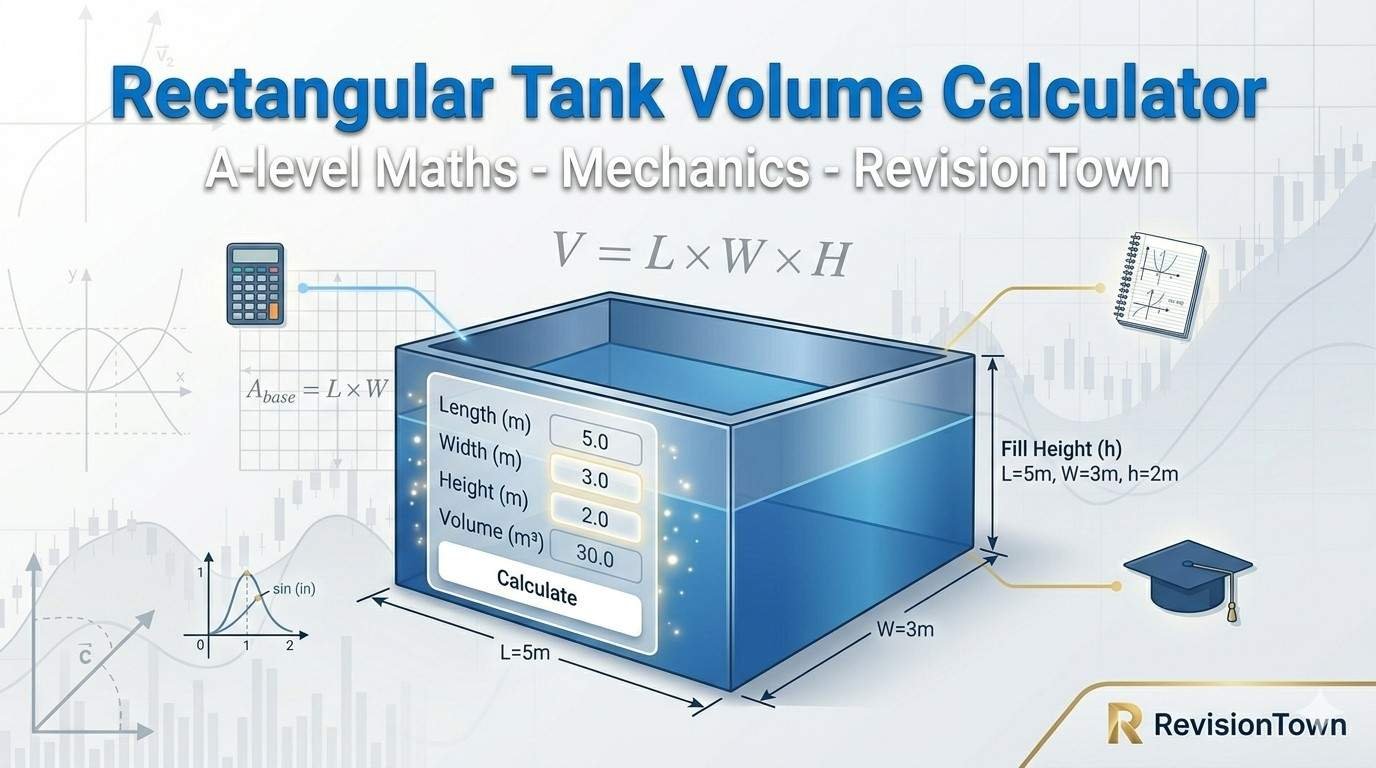
Rectangular Tank Volume Calculator
Calculate the volume and capacity of rectangular tanks accurately with our easy-to-use calculator. Perfect for construction, agriculture, and industrial applications.
What is a Rectangular Tank Volume Calculator?
A rectangular tank volume calculator is a digital tool that helps you determine the total capacity and volume of rectangular (cuboid) tanks quickly and accurately. This calculator is essential for engineers, construction professionals, farmers, and homeowners who need to plan water storage, estimate liquid capacity, or design storage systems.
Rectangular tanks, also known as rectangular prisms or cuboid tanks, are among the most common storage structures used in construction, agriculture, and industry. Unlike cylindrical tanks, rectangular tanks offer better space utilization and are easier to construct, making them a popular choice for water storage, chemical storage, and various industrial applications.
The calculator eliminates manual calculation errors and provides instant results in multiple units, including cubic meters, liters, gallons, and cubic feet. Whether you're designing a new tank, checking existing capacity, or planning liquid storage needs, this tool simplifies complex volume calculations into a straightforward process.
Volume Calculator Tool
Calculate Your Rectangular Tank Volume
Results
Volume Formulae
Total Tank Volume Formula
The volume of a rectangular tank (rectangular prism) is calculated by multiplying its three dimensions: length, width, and height.
Where:
- V = Volume of the tank (cubic units)
- l = Length of the tank
- w = Width of the tank
- h = Height of the tank
Filled Volume Formula
When you need to calculate the volume of liquid in a partially filled rectangular tank, use the fill height instead of the total height.
Where:
- Vfill = Filled volume (cubic units)
- l = Length of the tank
- w = Width of the tank
- f = Fill height (level of liquid)
Important Note: All dimensions must be in the same unit of measurement. The result will be in cubic units (e.g., if dimensions are in meters, the volume will be in cubic meters).
Volume to Capacity Conversion
Once you have the volume in cubic units, you can convert it to liquid capacity:
- 1 cubic meter (m³) = 1,000 liters = 264.17 US gallons
- 1 cubic foot (ft³) = 28.317 liters = 7.481 US gallons
- 1 cubic centimeter (cm³) = 1 milliliter (ml)
Uses and Applications
Rectangular tank volume calculators serve multiple industries and purposes. Understanding these applications helps you appreciate the versatility and importance of accurate volume calculations.
Construction and Architecture
- Water Storage Planning: Determine the size requirements for residential, commercial, and industrial water tanks
- Cost Estimation: Calculate material quantities needed for tank construction
- Building Code Compliance: Ensure water storage capacity meets regulatory requirements
- Space Optimization: Design tanks that fit efficiently within available space
Agriculture and Irrigation
- Irrigation Planning: Calculate water storage needed for crop irrigation systems
- Livestock Water Supply: Determine tank capacity for animal watering systems
- Rainwater Harvesting: Size storage tanks for collected rainwater
- Fertilizer Mixing: Calculate volumes for fertilizer solution preparation
Industrial Applications
- Chemical Storage: Determine capacity for chemical storage tanks in manufacturing
- Fuel Storage: Calculate volume for diesel and fuel storage systems
- Process Water: Size tanks for industrial process water requirements
- Waste Management: Plan capacity for wastewater collection and treatment
Residential and Commercial
- Swimming Pools: Calculate pool volume for chemical treatment and maintenance
- Aquarium Design: Determine water capacity for fish tanks and aquariums
- Emergency Water Storage: Plan backup water supply for homes and buildings
- Fire Protection Systems: Size water tanks for fire suppression systems
Education and Research
- Mathematics Education: Teach volume calculation and geometry concepts
- Engineering Studies: Practice real-world volume calculation problems
- Scientific Research: Calculate volumes for experimental setups and laboratory equipment
How to Calculate Tank Volume
Calculating rectangular tank volume is straightforward when you follow these systematic steps. Whether you're using the calculator or performing manual calculations, the process remains consistent.
Step 1: Measure the Length
Identify and measure the longest horizontal dimension of your rectangular tank. Use a tape measure or other measuring device, and record the length in your chosen unit (meters, feet, centimeters, or inches).
Step 2: Measure the Width
Measure the shorter horizontal dimension perpendicular to the length. This is the width of your tank. Ensure you use the same unit of measurement as you did for the length.
Step 3: Measure the Height
Measure the vertical dimension from the base to the top of the tank. If you need the filled volume, measure the fill height (the level of liquid) instead of the total height.
Step 4: Ensure Unit Consistency
Verify that all three measurements (length, width, height) are in the same unit. If they're not, convert them to a common unit before proceeding with the calculation.
Step 5: Apply the Formula
Multiply the three dimensions together: Volume = Length × Width × Height. The order of multiplication doesn't matter due to the commutative property.
Step 6: Express the Result
State your answer in cubic units (m³, ft³, cm³) based on the units used for measurement. You can then convert to liters or gallons if needed.
Practical Example
Problem: Calculate the volume of a rectangular water tank with dimensions 4 meters long, 3 meters wide, and 2 meters high.
Solution:
V = l × w × h
V = 4 m × 3 m × 2 m
V = 24 m³
Converting to liters: 24 m³ × 1,000 = 24,000 liters
Answer: The tank can hold 24 cubic meters or 24,000 liters of water.
How This Calculator Works
Our rectangular tank volume calculator uses a simple yet precise methodology to deliver accurate results instantly. Understanding how it works helps you use it more effectively and troubleshoot any issues.
Input Processing
When you enter the tank dimensions (length, width, height) and select your unit of measurement, the calculator first validates your inputs to ensure they are positive numbers. This prevents calculation errors and ensures data integrity.
Unit Standardization
The calculator converts all inputs to a standard base unit (meters) internally. This standardization allows for consistent calculations regardless of which measurement system you choose. The conversion factors used are:
- Meters (m): 1 (base unit)
- Centimeters (cm): 0.01 meters
- Feet (ft): 0.3048 meters
- Inches (in): 0.0254 meters
Volume Calculation
After standardization, the calculator applies the fundamental volume formula: V = l × w × h. This multiplication gives the volume in cubic meters (m³). For filled volume calculations, the calculator uses the fill height instead of total height.
Multi-Unit Output
The calculated volume is then converted to multiple units for your convenience:
- Cubic meters (m³): Standard SI unit for volume
- Liters (L): Common for liquid capacity (1 m³ = 1,000 L)
- Cubic feet (ft³): Imperial unit (1 m³ ≈ 35.315 ft³)
- US Gallons: Common in the United States (1 m³ ≈ 264.172 gallons)
Result Display
The calculator presents results in an easy-to-read format, showing both total volume and filled volume (if applicable). All values are rounded to two decimal places for practical use while maintaining sufficient precision for most applications.
Accuracy and Precision
The calculator uses JavaScript's built-in mathematical functions, which provide high precision (up to 15-17 significant digits). For practical purposes, results are displayed with appropriate rounding, but the underlying calculations maintain full precision.