
This lesson covers:
- How energy can be stored and transferred
- The relationship between force, distance moved, and energy transferred
- Calculating the energy transferred when an object moves
Energy transfers are linked to forces and distances
When a force makes an object move, energy is transferred.
The amount transferred depends on:
- The force applied in newtons (N)
- The distance moved in metres (m)
This relationship between force, distance moved and energy transferred is described by the equation:
Energy transferred (J) = Force (N) × Distance moved (m)
So if a large force moves something a small distance, the same amount of energy can be transferred as a smaller force acting over further distance.
Calculating energy transfers
To find the energy transferred when a force moves an object:
- State the force in newtons (N)
- State the distance moved in metres (m)
- Substitute these values into the equation:
- Energy transferred (J) = Force (N) × Distance moved (m)
Calculating energy transfer example
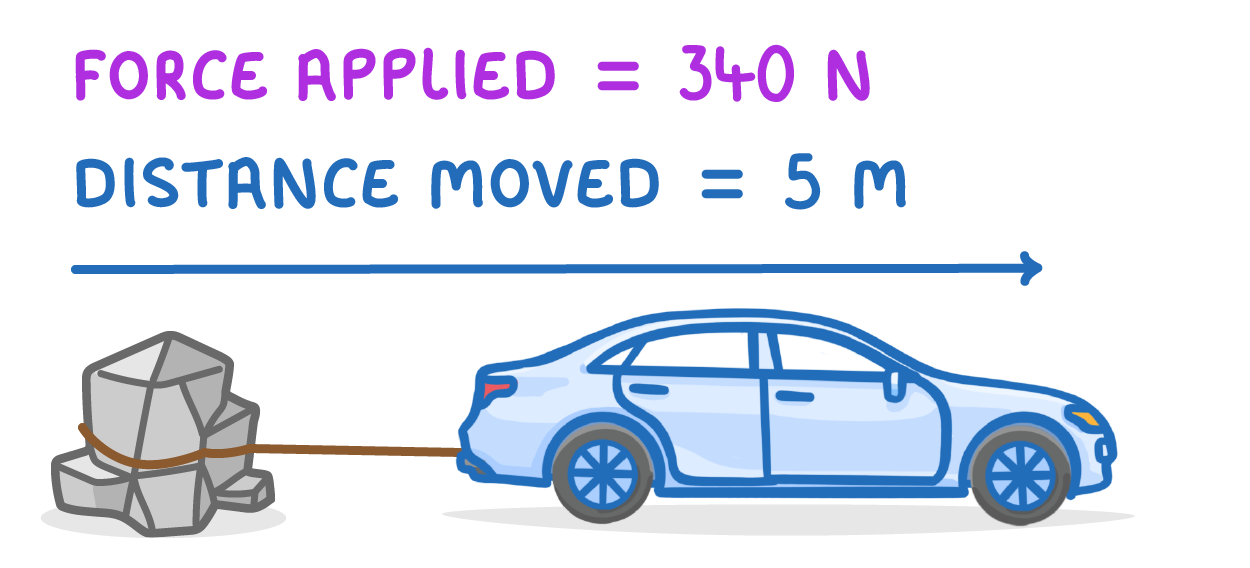
For example, if a person pulls a tire 5 m with a force of 340 N:
Step 1 Formula:
Energy transferred (J) = Force (N) × Distance moved (m)
Step 2 Substitution and correct evaluation:
E = 340 x 5 = 1,700 J
PRACTICE QUIZ
1. How is energy transferred when an object moves?
Answer: Energy is transferred when an object moves due to the application of a force over a distance. This transfer of energy is quantified by the equation E=F×d, where E is energy, F is force, and d is distance.
2. What is the formula for calculating energy transfer?
Answer: The formula for calculating energy transfer is E=F×d, where E is the energy transferred in joules (J), F is the force applied in newtons (N), and d is the distance moved in meters (m).
3. What units are used for energy transfer?
Answer: Energy transfer is measured in joules (J), force in newtons (N), and distance in meters (m).
4. What is the relationship between force and distance in energy transfer?
Answer: The relationship is directly proportional; the energy transferred increases with either an increase in force or an increase in distance, as described by the formula E=F×d.
5. How does force affect the amount of energy transferred?
Answer: The greater the force applied to move an object, the more energy is transferred, assuming the distance moved remains constant.
6. How does distance affect the amount of energy transferred?
Answer: The greater the distance over which a force is applied, the more energy is transferred, assuming the force remains constant.
7. What is an example of calculating energy transfer?
Answer: If a force of 100 N moves an object 3 meters, the energy transferred is calculated as E=100×3=300 joules.
8. How do you calculate the energy transferred if you know the force and distance?
Answer: Multiply the force (N) by the distance (m) to find the energy transferred in joules (J).
9. What is the energy transferred when a 200 N force moves an object 10 m?
Answer: The energy transferred is E=200×10=2,000 joules.
10. How does energy transfer relate to work done?
Answer: Energy transfer is equivalent to the work done on an object when a force moves it over a distance. Both are measured in joules.
11. What is the definition of work done in physics?
Answer: Work done is the energy transferred when a force moves an object over a distance, calculated using W=F×d.
12. Can energy be transferred without moving an object?
Answer: Yes, energy can be transferred in other forms such as thermal energy (heating), electrical energy, and radiation without necessarily moving an object.
13. What is an example of energy transfer by heating?
Answer: An example is a stove heating a pot of water. Thermal energy from the stove is transferred to the water, increasing its temperature.
14. What is an example of energy transfer by radiation?
Answer: An example is the Sun transferring energy to Earth through sunlight (electromagnetic radiation).
15. How does electrical energy transfer occur?
Answer: Electrical energy transfer occurs when electric charges move through a conductor, such as in an electric circuit powering a light bulb.
16. How does mechanical energy transfer occur?
Answer: Mechanical energy transfer occurs when forces act on objects, causing motion or deformation, such as pushing a box across the floor.
17. What is the principle of conservation of energy?
Answer: The principle of conservation of energy states that energy cannot be created or destroyed, only transferred or converted from one form to another.
18. How do you calculate the power of an energy transfer?
Answer: Power is calculated as the rate of energy transfer over time, using the formula P=tE, where P is power in watts (W), E is energy in joules (J), and t is time in seconds (s).
19. What is the unit of power in energy transfer?
Answer: The unit of power is the watt (W), where 1 watt equals 1 joule per second (1 W = 1 J/s).
20. What is an example of power calculation in energy transfer?
Answer: If 1,000 joules of energy are transferred in 5 seconds, the power is P=51,000=200 watts.
21. How does efficiency relate to energy transfer?
Answer: Efficiency measures how effectively energy is transferred or converted without losses, calculated as the ratio of useful energy output to total energy input, expressed as a percentage.
22. What is an example of calculating efficiency in energy transfer?
Answer: If a machine uses 500 J of energy and produces 400 J of useful work, its efficiency is 500 / 400×100=80%.
23. What are common forms of energy transfer in everyday life?
Answer: Common forms include mechanical work (lifting objects), thermal transfer (heating), electrical transfer (powering devices), and radiative transfer (sunlight).
24. How does energy transfer in a swinging pendulum?
Answer: Energy transfers between gravitational potential energy at the highest points and kinetic energy at the lowest point during the swing.
25. How does friction affect energy transfer?
Answer: Friction converts some mechanical energy into thermal energy, reducing the amount of useful energy transferred for work.
26. What is the role of energy transfer in ecosystems?
Answer: In ecosystems, energy transfers through food chains from producers (plants) to consumers (animals) and decomposers, driving biological processes.
27. How does energy transfer in a roller coaster?
Answer: Energy transfers between gravitational potential energy at the peaks and kinetic energy during the drops and loops.
28. What is thermal energy transfer by conduction?
Answer: Conduction is the transfer of thermal energy through direct contact between particles, typically in solids.
29. What is thermal energy transfer by convection?
Answer: Convection is the transfer of thermal energy through the movement of fluids (liquids or gases), where warmer, less dense regions rise and cooler, denser regions sink.
30. What is thermal energy transfer by radiation?
Answer: Radiation is the transfer of thermal energy through electromagnetic waves, such as infrared radiation, without needing a medium.
31. How does energy transfer in an electric circuit?
Answer: In an electric circuit, electrical energy is transferred from the power source to electrical components (like bulbs or motors) through the movement of electric charges.
32. What is an example of energy transfer in a car engine?
Answer: In a car engine, chemical energy from fuel is converted into thermal energy through combustion, and this thermal energy is then converted into kinetic energy to move the car.
33. How does energy transfer in a hydroelectric power plant?
Answer: In a hydroelectric power plant, gravitational potential energy of water stored in a reservoir is converted into kinetic energy as it flows downhill, which then turns turbines to generate electrical energy.
34. What is an example of energy transfer in photosynthesis?
Answer: In photosynthesis, light energy from the sun is converted into chemical energy stored in glucose molecules by plants.
35. How does energy transfer in a solar panel?
Answer: In a solar panel, light energy from the sun is converted into electrical energy through the photovoltaic effect.
36. How does energy transfer in a wind turbine?
Answer: In a wind turbine, kinetic energy from the wind is converted into mechanical energy as the blades turn, which is then transformed into electrical energy by a generator.
37. What is an example of energy transfer in a muscle contraction?
Answer: In muscle contraction, chemical energy stored in ATP molecules is converted into kinetic energy, enabling movement.
38. How does energy transfer in a pendulum clock?
Answer: In a pendulum clock, gravitational potential energy is converted into kinetic energy as the pendulum swings, and this motion is used to keep time.
39. How does energy transfer in a geothermal power plant?
Answer: In a geothermal power plant, thermal energy from the Earth’s interior is converted into mechanical energy by turbines, which is then transformed into electrical energy.
40. What is an example of energy transfer in a refrigerator?
Answer: In a refrigerator, electrical energy is used to power a compressor, which transfers thermal energy from inside the fridge to the outside, keeping the interior cool.
41. How does energy transfer in a battery-powered device?
Answer: In a battery-powered device, chemical energy stored in the battery is converted into electrical energy, which powers the device’s functions.
42. What is an example of energy transfer in a hydrothermal vent?
Answer: In a hydrothermal vent, thermal energy from the Earth’s interior is transferred to water, creating hot, mineral-rich fluids that support unique ecosystems.
43. How does energy transfer in a nuclear power plant?
Answer: In a nuclear power plant, nuclear energy from fission reactions is converted into thermal energy, which generates steam to drive turbines, producing electrical energy.
44. What is an example of energy transfer in a windmill?
Answer: In a windmill, kinetic energy from the wind is converted into mechanical energy to grind grain or pump water.
45. How does energy transfer in a chemical reaction?
Answer: In a chemical reaction, chemical energy stored in bonds is converted into other forms of energy, such as thermal, light, or electrical energy, depending on the reaction.
46. What is an example of energy transfer in a radio?
Answer: In a radio, electrical energy is converted into electromagnetic waves (radio waves), which are then converted back into electrical energy and finally into sound energy.
47. How does energy transfer in a power plant?
Answer: In a power plant, various forms of energy (chemical, nuclear, or kinetic) are converted into electrical energy, which is then distributed through the grid to power homes and businesses.
48. How does energy transfer in a wind-up toy?
Answer: In a wind-up toy, elastic potential energy stored in a spring is converted into kinetic energy, causing the toy to move.
49. What is an example of energy transfer in a flashlight?
Answer: In a flashlight, chemical energy in the batteries is converted into electrical energy, which is then transformed into light energy by the bulb.
50. How does energy transfer in a solar water heater?
Answer: In a solar water heater, light energy from the sun is absorbed and converted into thermal energy, which heats the water in the system.